Short answer: Practical HR compliance webinars come from five places: specialist training providers that are SHRM and HRCI approved, local SHRM chapters, employment law firms, payroll and HR software companies, and government agencies such as E-Verify. Wherever you look, match the speaker to the topic: an attorney for employment law, a Certified Payroll Professional (CPP) for payroll, an Enrolled Agent (EA) for payroll tax, and a senior HR practitioner for policy and investigations.
What "practical" actually looks like
Most HR professionals can tell within ten minutes whether a webinar will be useful. The practical ones share a few habits:
- They show the real thing. The actual Form W-4, the actual OSHA 300 log, a real (anonymized) investigation note, not a slide that says "documentation is important".
- They give decision rules. "If the employee works in two states, start here" beats a tour of every state law.
- They talk about mistakes. People who have done the job know where it goes wrong and say so.
- They leave room for questions. The best part of a live session is often the Q&A, because that’s where your own situation comes up.
- You leave with something. A checklist, a template, a timeline you can use on Monday.
The common thread is the speaker. Someone who has run payroll through a year-end close, sat across from an investigator or answered an audit letter teaches differently from someone who learned the topic to present it.
Where to find them
1. SHRM- and HRCI-approved training providers
Companies that specialize in HR and payroll compliance webinars are the most consistent source, because building a speaker roster is their whole business. Look for two things on the provider’s site: the SHRM Recertification Provider badge and HRCI approved-provider status, plus a speakers page with real bios. If you can’t find out who teaches, move on.
2. Your local SHRM chapter
Chapter meetings often feature local employment attorneys and senior HR leaders, and many chapters can award PDCs. The quality varies by chapter, but the networking and the local-law angle are hard to get anywhere else.
3. Employment law firms
Many firms run free client webinars on new laws and court decisions. They’re excellent for "what changed" and taught by people who litigate these issues. They’re lighter on operations, because the firm’s job is legal advice, not your checklist.
4. Payroll and HR software companies
Vendors run free webinars to stay in front of buyers, and some carry credit. Patriot Software, for example, offers 1 HRCI credit and 1 SHRM PDC to live attendees of eligible payroll webinars. Expect a short product mention. The teaching can still be solid.
5. Government agencies
Agency webinars give you the rule from the source. E-Verify’s free webinars on Form I-9 and E-Verify are eligible for SHRM and HRCI credit, with a couple of exceptions listed on its site.
Match the credential to the topic
A credential doesn’t make someone a good teacher, but it tells you what they’ve been tested on and what they’re accountable for. Use it as a first filter.
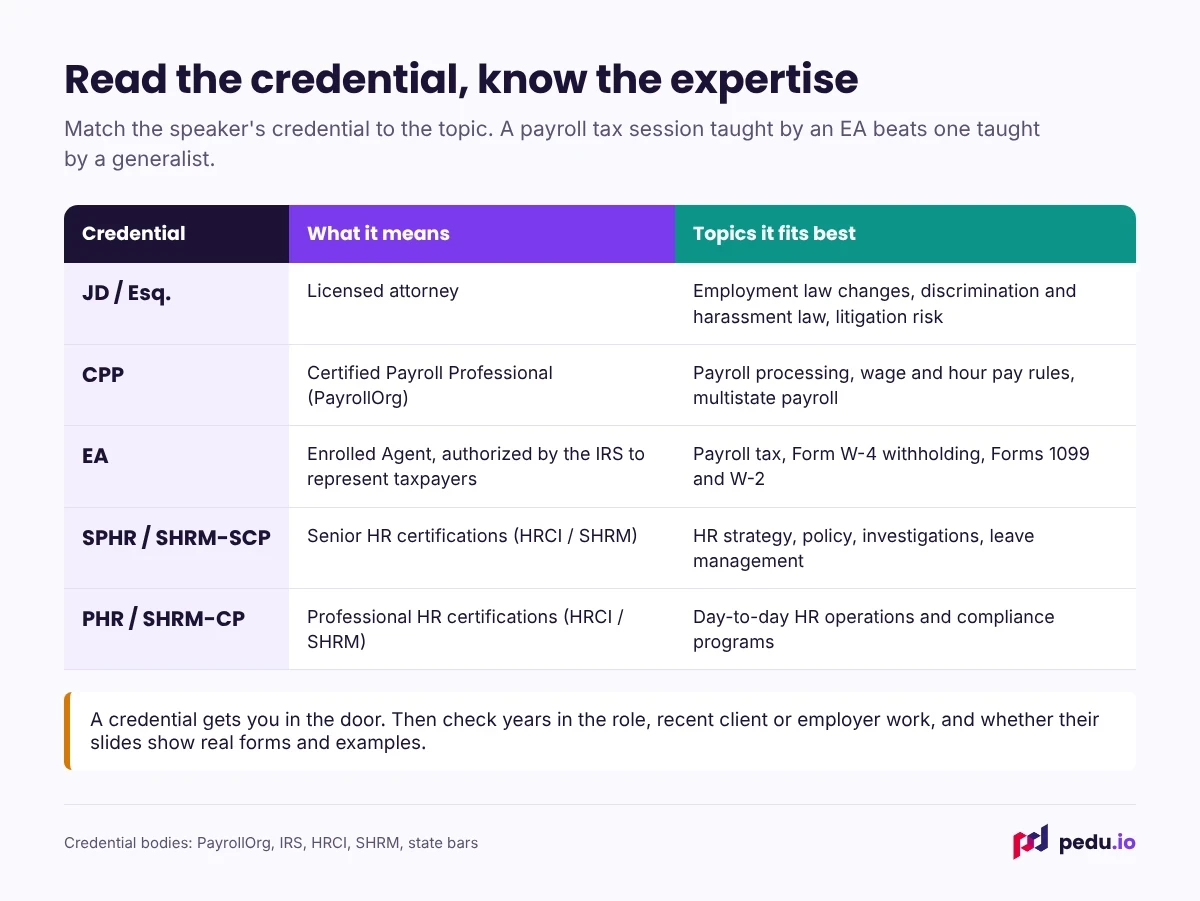
Two combinations deserve a closer look. Payroll tax topics such as W-4 withholding or Forms 1099 are best taught by an EA or a CPP, because those credentials cover the tax side directly. Employment law topics with legal risk, like a new discrimination rule, are best taught by an attorney. A generalist can teach both well, but they should have to prove it.
Vet any speaker in five minutes
Before you register, run through this quickly:
- Read the bio, then check it. Does their LinkedIn or firm page match? Look for current work in the field, not just past titles.
- Count the years and the context. "20 years in HR" means more when you can see where: a 50-person company and a 50,000-person company teach different lessons.
- Look for their own material. A book, articles, a blog or a newsletter shows how they explain things. You’ll know within a page whether they’re practical.
- Check recency. For anything that changes yearly, like payroll tax or leave law, the speaker should be working on it now.
- Ask the provider. A good provider will tell you what the session covers, how long the Q&A runs and whether slides or a transcript come with it.
Red flags
- No speaker named, or a bio with no organization or dates
- A description that lists topics but no outcomes ("we’ll discuss FMLA")
- Credit claims without a provider badge or credit numbers
- Promises like "everything you need to know" in 60 minutes
- A speaker who sells the same service the webinar tells you that you need, without saying so
Pedu’s approach
Pedu was built around this idea, so it’s fair to show how we do it. Our sessions are taught by working practitioners, for example:
- Vicki M. Lambert, CPP, President and Academic Director of The Payroll Advisor
- Debbie Cash, CPP, payroll and time and labor management specialist
- Patrick A. Haggerty, EA, payroll tax and FLSA compliance
- Janette S. Levey, Esq., employment law, with more than 20 years of legal experience
- Diane L. Dee, SPHR, SHRM-SCP, HR consultant with more than 25 years of experience
- Margie Faulk, PHR, SHRM-CP, HR compliance, more than 15 years in senior HR roles
- Suzanne Lucas, who spent 10 years in corporate HR before consulting
Every credit-eligible session carries SHRM PDCs and HRCI credit, and every bio is on the speakers page. Check our accreditation details, then browse the upcoming live webinars.
Frequently asked questions
What makes an HR compliance webinar practical rather than theoretical?
A practical webinar shows real forms and real examples, gives you decision rules for common situations, names the mistakes people make, leaves time for questions and hands you something you can use right away, like a checklist or template.
What credentials should an HR compliance trainer have?
It depends on the topic. Look for a licensed attorney on employment law, a CPP on payroll operations, an Enrolled Agent or CPP on payroll tax, and an SPHR, SHRM-SCP or long-serving HR leader on policy and investigations. Then confirm they’re doing that work now.
What is the difference between a CPP and an EA?
A CPP (Certified Payroll Professional) is a payroll credential from PayrollOrg that covers payroll operations, wage and hour pay rules and payroll compliance. An EA (Enrolled Agent) is authorized by the IRS to represent taxpayers, so their strength is tax: withholding, information returns and IRS notices.
Should employment law webinars always be taught by a lawyer?
Not always, but for new or contested rules, an attorney is the safer choice. They can tell you how agencies and courts are reading the rule. For operational topics, such as running FMLA paperwork, an experienced HR practitioner is often more useful.
Are free employment law webinars from law firms worth attending?
Yes, for updates. They’re usually taught by attorneys who handle these cases, and some carry SHRM or HRCI credit. They’re lighter on implementation, so pair them with a practitioner-led session when you need the checklist.
Do local SHRM chapter meetings count for PDCs?
Often, yes. SHRM chapters and state councils can become SHRM Recertification Providers and award PDCs for educational programs. Check the meeting notice for the PDC amount and the activity ID.
Are webinars run by HR software vendors biased?
They include a product mention, so expect some. The teaching itself can still be accurate, especially when a credentialed specialist presents. Judge the session on whether you’d learn the same thing without buying the product.
How can I check a speaker’s experience before I register?
Read the provider’s bio, then check their LinkedIn or firm page for current work in the field. Look for articles, books or past sessions they’ve published. If the provider won’t tell you who teaches the session, that’s your answer.
Can my whole HR team learn from the same expert?
Yes. Most providers sell team access. At Pedu, team rates are built into each webinar page (one rate for 5 to 10 attendees and another for 11 or more), and each attendee gets their own credit certificate. Larger teams can ask about corporate training.