Short answer: The best live HR compliance webinar is the one you take 4 to 8 weeks before a deadline you actually face. For most U.S. employers that means year-end payroll and Forms W-2 and 1099 in November or December, OSHA recordkeeping in January, leave and accommodation in spring, benefits plan filings before summer, and open enrollment in early fall. Pick sessions taught by people who handle that deadline themselves, with real time set aside for questions.
What makes a live compliance webinar worth your time
A catalog full of good titles doesn’t help if the timing is wrong. A live session earns its slot on your calendar when it passes four tests:
- It lands before a deadline you face, early enough to fix what you learn.
- The speaker does this work, whether that’s running payroll, keeping OSHA logs or advising on leave.
- There’s real Q&A time, at least 15 minutes, because deadline questions are specific ("we have one employee in a second state, does that change our W-2s?").
- It carries credit, so the hour also counts toward your SHRM or HRCI recertification.
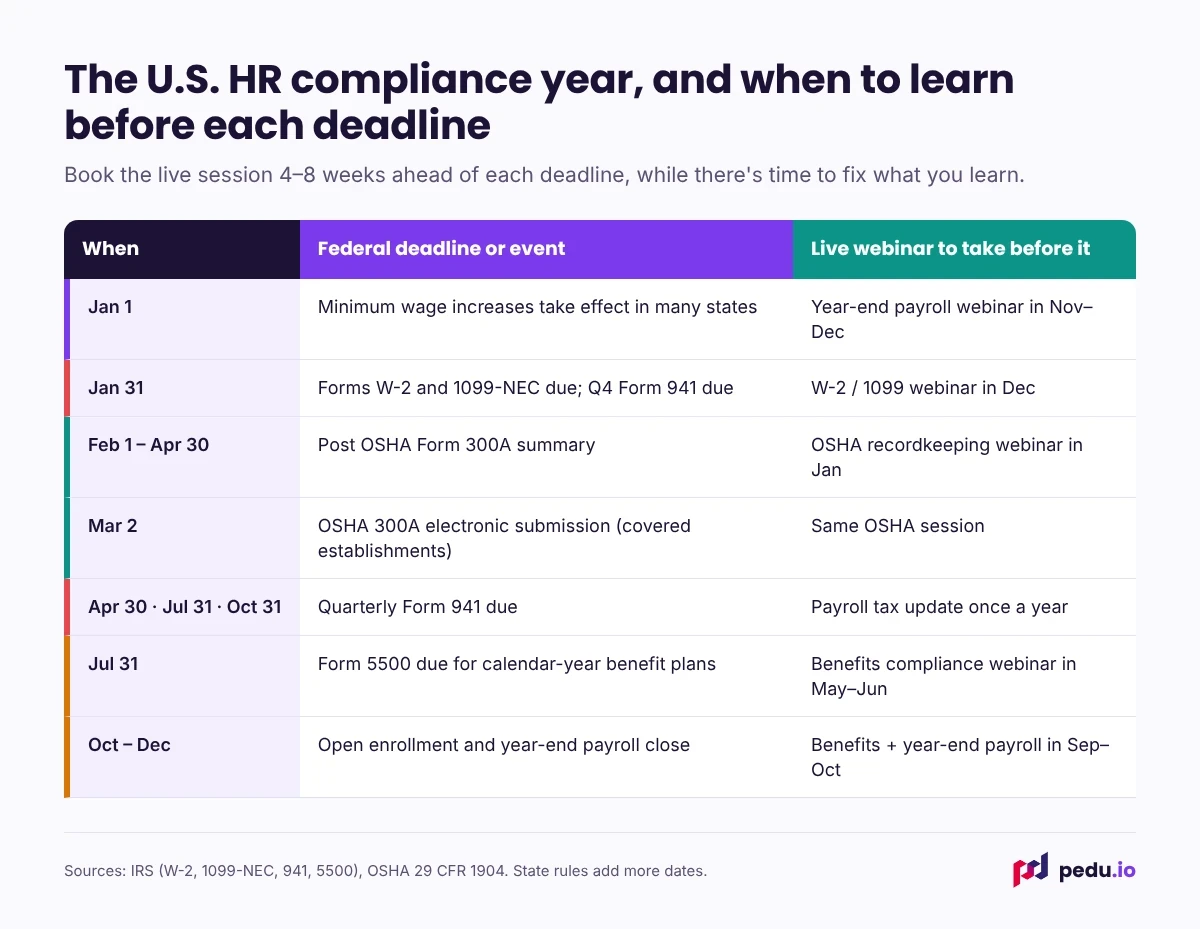
The U.S. HR compliance year at a glance
These are federal dates that hit most employers. Your states will add their own, from new-hire reporting to paid leave notices.
Month by month: which live webinars to book
November and December: year-end payroll, W-2s and 1099s
Forms W-2 and 1099-NEC are due January 31, and the fourth-quarter Form 941 is due the same day. Many states also raise their minimum wage on January 1. A live year-end payroll session in November gives you time to clean up employee data, confirm taxable fringe benefits and reconcile before the rush.
This year has an extra reason to attend. The One Big Beautiful Bill Act raised the reporting threshold for Forms 1099-NEC and 1099-MISC from $600 to $2,000 for payments made after December 31, 2025. The forms you file in January 2027 are the first ones affected, so expect questions about which vendors and contractors still need a form.
January: OSHA recordkeeping
Employers that keep OSHA injury and illness records must post the Form 300A summary from February 1 to April 30. Many covered establishments must also submit it electronically by March 2. A January session on OSHA recordkeeping helps you check what counts as recordable, close out last year’s log correctly and get the summary signed by a company executive in time.
March to May: leave, accommodation and handbook updates
Spring is a good window for the topics that cause the most employee-relations trouble: FMLA, ADA accommodation and the places where they overlap with workers’ comp. It’s also when many HR teams update their handbooks for state law changes that took effect January 1. Live sessions matter here, because leave questions are almost always about a specific employee.
May and June: benefits plan filings
Form 5500 for a calendar-year benefit plan is due July 31, the same day as the second-quarter Form 941. A benefits compliance webinar in May or June leaves time to gather plan data from your broker or recordkeeper.
September and October: open enrollment
Open enrollment usually runs in October and November. A session in September or early October on benefits notices, plan changes and enrollment communication pays off before employees start asking questions.
Any time of year: investigations, I-9 and wage and hour
Some topics don’t follow the calendar. Book a harassment and discrimination investigations session, a Form I-9 refresher and an FLSA overtime and exemption session at least once a year, at whatever point your schedule allows.
A sample 12-session year
Here’s how that turns into a plan, assuming 60- to 90-minute sessions:
- November: year-end payroll and Forms W-2 and 1099, ahead of the January 31 deadlines (1.5 credits)
- December: state law changes for the new year, ahead of January 1 effective dates (1.0)
- January: OSHA recordkeeping and Form 300A, ahead of the February 1 posting (1.0)
- February: FLSA overtime and exemptions, before mid-year reviews and raises (1.5)
- March: FMLA and ADA together, for leave season and the tricky cases (1.5)
- April: handbook update, once new state laws are in force (1.0)
- May: benefits plan compliance and Form 5500, ahead of the July 31 filing (1.5)
- June: harassment and EEOC investigations, any time, but mid-year works well (1.5)
- July: multistate payroll tax, as remote hiring picks up mid-year (1.5)
- August: Form I-9 and E-Verify, before fall hiring (1.0)
- September: open enrollment and benefits notices, ahead of October enrollment (1.0)
- October: year-ahead payroll and HR outlook, for planning next year (1.0)
That’s 15 credits from live sessions. Add a handful of recorded sessions on topics you missed and you’re at 20 credits a year, exactly the pace for a 60-credit, 3-year SHRM or HRCI cycle.
Recent examples from Pedu’s live calendar
Pedu’s live sessions follow this rhythm. Recent ones include OSHA 300 logs and recordkeeping requirements with Matthew Burr, EEOC harassment and discrimination investigations with Diane L. Dee, SPHR, SHRM-SCP, and multistate employee taxation with Vicki M. Lambert, CPP. Sessions you’ve missed move to the recorded library, with the same SHRM and HRCI credit.
Check the webinar calendar for upcoming dates, register from live webinars, or catch up in the recorded sessions.
Frequently asked questions
Which HR and payroll deadlines fall in January?
Forms W-2 go to employees and the Social Security Administration by January 31. Forms 1099-NEC go to recipients and the IRS by the same date, as does the fourth-quarter Form 941. Many states also raise their minimum wage on January 1, so pay rates need updating before the first payroll of the year.
When do employers have to post the OSHA Form 300A?
Employers that must keep OSHA injury and illness records post the Form 300A summary of the previous year from February 1 through April 30, in a place where employees normally see notices. A company executive must certify it.
Who has to submit the OSHA Form 300A electronically?
Generally, establishments with 250 or more employees in industries that must keep OSHA records, and establishments with 20 to 249 employees in designated higher-hazard industries. The submission is due March 2. Check OSHA’s Injury Tracking Application for your establishment’s status.
When is Form 5500 due?
By the last day of the seventh month after the plan year ends. For a calendar-year plan, that’s July 31. Plan sponsors can request an extension, but it has to be filed before the original due date.
What changed for Form 1099-NEC reporting in 2026?
The One Big Beautiful Bill Act raised the reporting threshold for Forms 1099-NEC and 1099-MISC from $600 to $2,000 for payments made after December 31, 2025. The first forms affected are the ones filed in early 2027 for 2026 payments.
How far ahead of a deadline should I take a compliance webinar?
Four to eight weeks. That’s early enough to fix data, update policies or ask your vendor for reports, and close enough that the details are still fresh when the deadline arrives.
Which HR compliance topics need a refresher every year?
Year-end payroll and information returns, OSHA recordkeeping, FLSA overtime and exemptions, leave and accommodation, Form I-9, and harassment and discrimination investigations. These either repeat on a yearly cycle or change often enough that last year’s knowledge goes stale.
What should an HR team of one prioritize on the compliance calendar?
The deadlines that carry penalties: Forms W-2 and 1099, quarterly payroll tax filings, Form I-9 for every new hire and, if you keep OSHA records, the Form 300A posting. Even if a payroll provider files the forms, you still own the data on them, so one year-end payroll session a year is worth it.
Do state laws add more HR deadlines?
Yes. States add their own posters, new-hire reporting, paid leave notices, pay transparency rules and minimum wage changes. If you have employees in several states, add a state-law session to your plan each year.
What if I miss a live compliance webinar right before a deadline?
Watch the recording as soon as it’s available. At Pedu that’s within 24 hours, in your account. If you have a question the recording doesn’t answer, contact support and ask for it to be passed to the speaker.