Workplace complaints can create legal, operational, and employee-relations challenges when they are not handled promptly and objectively. Allegations involving harassment, discrimination, retaliation, bullying, fraud, safety violations, or employee misconduct require a structured process that establishes what happened and supports a fair response.
Understanding how to conduct a workplace investigation helps HR professionals gather reliable evidence, protect employee rights, identify potential policy violations, and make better-informed decisions. A consistent investigation process also demonstrates that employee concerns are taken seriously and assessed on their merits.
A workplace investigation should not be designed to prove that a complaint is true or false before the evidence has been reviewed. Its purpose is to establish the relevant facts, assess the available evidence, and determine whether organizational policies or applicable legal requirements have been violated.
This guide explains the workplace investigation process in 10 practical steps, from complaint intake and evidence preservation to interviews, investigation reporting, corrective action, and follow-up. It also includes a workplace investigation checklist, a report template, and answers to 15 frequently asked questions.
HR professionals who handle sensitive employee complaints can explore Pedu’s HR compliance webinars and professional training for additional learning opportunities relevant to their responsibilities.
What Is a Workplace Investigation
A workplace investigation is a formal or structured fact-finding process used to examine allegations of misconduct, employee complaints, policy violations, or other workplace concerns.
The process typically involves collecting relevant information, interviewing people with potentially useful knowledge, reviewing records, assessing conflicting accounts, and documenting conclusions supported by the available evidence.
Depending on the circumstances, an investigation may be conducted by an HR professional, employee relations specialist, trained manager, compliance officer, internal legal team, or independent external investigator.
Common reasons to conduct a workplace investigation include:
- Sexual harassment or other forms of workplace harassment.
- Discrimination based on a legally protected characteristic.
- Retaliation against employees who report concerns or participate in protected processes.
- Bullying, intimidation, threats, or inappropriate workplace conduct.
- Fraud, theft, conflicts of interest, or financial misconduct.
- Workplace safety complaints and violations of internal procedures.
- Breaches of company policies, codes of conduct, or confidentiality requirements.
- Whistleblower reports and allegations of management misconduct.
Not every workplace disagreement requires a full formal investigation. However, employers should assess each complaint carefully and avoid dismissing serious allegations as personality conflicts without examining the underlying facts.
The appropriate response depends on the allegations, potential harm, company policy, applicable law, and reliability of the information initially available.
Why Workplace Investigations Matter
An effective workplace investigation helps an organization respond to employee concerns in a consistent, evidence-based manner.
Legal and compliance risk management: A timely, reasonable investigation can help an employer demonstrate that allegations were addressed appropriately. The investigation must still comply with the legal requirements relevant to the organization and the particular complaint.
Fair employee treatment: Giving relevant parties a meaningful opportunity to share information reduces the risk of decisions based on incomplete accounts or unsupported assumptions.
Reliable decision-making: Evidence-based findings help HR determine whether corrective action, further review, training, policy changes, or other measures are appropriate.
Workplace trust: Employees are more likely to take reporting procedures seriously when complaints are handled professionally and consistently.
Early identification of wider problems: An investigation may uncover recurring conduct, management weaknesses, inadequate reporting channels, or gaps in workplace policies.
For U.S. employers, the EEOC’s quality practices for effective investigations and conciliations provide context on structured fact-finding in discrimination-charge investigations conducted by the agency. This resource is EEOC-specific guidance, not a universal legal procedure for every internal workplace investigation.
How to Conduct a Workplace Investigation in 10 Steps
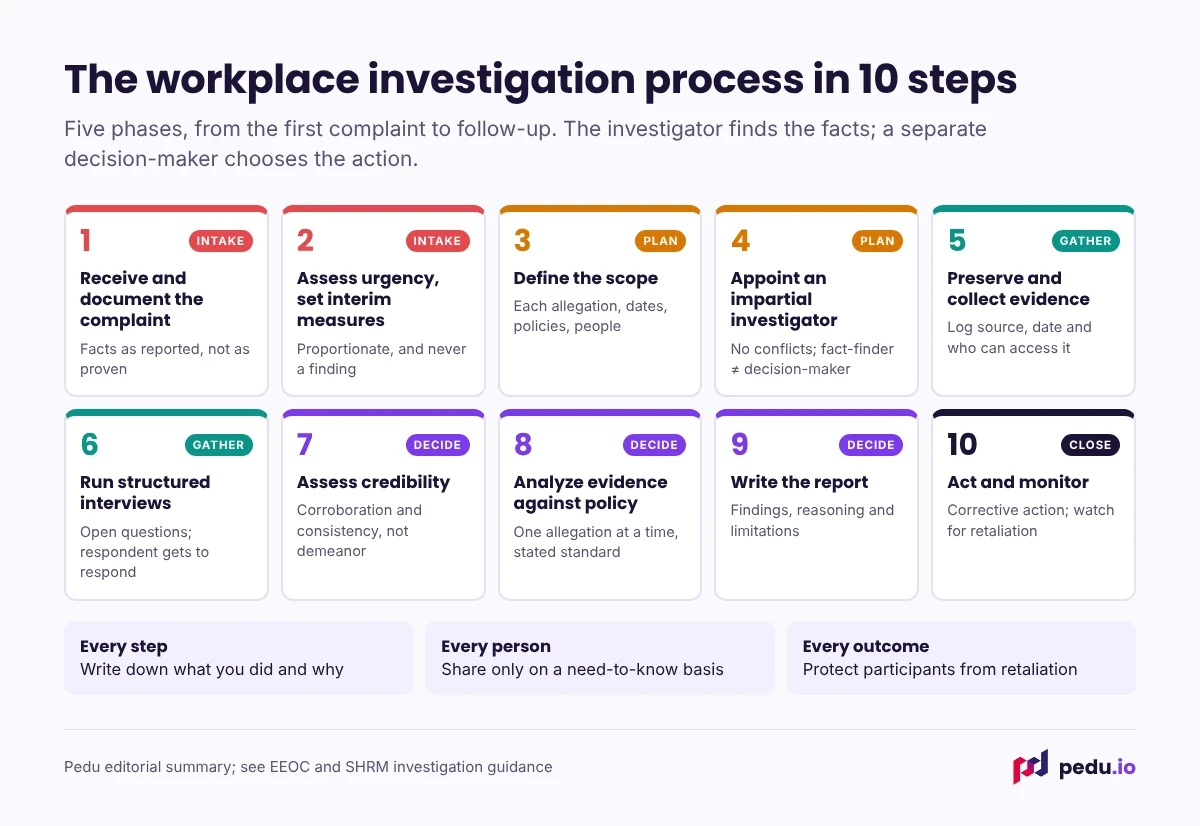
Step 1: Receive and Document the Complaint
Every investigation begins with a clear record of the concern. Complaints may arrive through a formal grievance, HR email, management referral, ethics hotline, employee interview, or third-party report.
Record the information available at intake without treating allegations as established facts.
The initial record should include:
- The date the concern was received.
- The identity and contact details of the reporting person, where known.
- The people involved and their relevant workplace roles.
- A description of the alleged conduct.
- The approximate dates, times, and locations of incidents.
- Names of potential witnesses.
- Available documents, messages, photographs, or other evidence.
- Any immediate safety concerns or risks of further harm.
- Relevant company policies and reporting procedures.
Ask the reporting employee to describe events in their own words. Clarify important details without suggesting answers or pressuring the person to adopt a particular interpretation.
If information is incomplete, document the gaps and identify what needs to be established next.
Practical tip: Separate direct observations from assumptions, interpretations, and information reported by other people. This distinction helps investigators assess the evidence accurately later.
Step 2: Assess Urgency and Implement Appropriate Interim Measures
Some complaints require immediate action before the investigation is complete.
For example, an allegation involving threats, potential violence, continuing harassment, interference with evidence, or possible retaliation may require urgent risk assessment.
Depending on the circumstances, interim measures may include:
- Arranging temporary reporting-line changes.
- Adjusting work schedules or locations.
- Restricting access to relevant systems or records.
- Providing workplace safety support.
- Preserving relevant electronic communications.
- Reminding involved employees about anti-retaliation policies.
- Escalating urgent concerns to legal, security, compliance, or senior HR personnel.
Interim measures should be proportionate to the risk and should not be treated as a final finding of misconduct.
Avoid automatically disadvantaging the person who raised the complaint. Assess any temporary arrangements for fairness, operational necessity, confidentiality, and potential legal implications.
Document why each measure was selected, who approved it, when it began, and when it should be reviewed.
Step 3: Define the Investigation Scope
A workplace investigation needs a clearly defined scope to remain focused and complete.
Identify the specific allegations, relevant dates, applicable policies, people involved, and questions that must be answered. Determine whether the investigation concerns a single incident or a potential pattern of conduct.
For example, a complaint about repeated inappropriate comments may require examining individual incidents, the surrounding context, previous reports, relevant communications, and whether company policy was followed.
The scope should identify:
- Each allegation that needs to be examined.
- The relevant period and workplace locations.
- The policies or standards potentially involved.
- The people who may have relevant information.
- The evidence required to test each allegation.
- Any related issues that may require separate review.
- The expected reporting and decision-making process.
Do not expand the investigation unnecessarily, but do not ignore credible information about related misconduct simply because it was not included in the original complaint. Assess new allegations and document any decision to expand the scope.
A written investigation plan helps prevent missed evidence, unnecessary interviews, and inconsistent treatment of similar cases.
Step 4: Appoint an Impartial and Competent Investigator
The investigator should have the skills, authority, and independence required for the case.
An HR professional may be suitable for a routine policy complaint. More complex allegations involving senior executives, potential discrimination claims, whistleblower concerns, financial misconduct, or serious conflicts of interest may require legal oversight, specialist investigators, or independent external support.
Before appointing an investigator, assess:
- Whether they have relevant investigation training.
- Whether they have a personal or professional connection to the people involved.
- Whether they can assess evidence without favoring either side.
- Whether they understand the applicable company policies.
- Whether the case presents legal or regulatory complexity.
- Whether an external investigator would provide necessary independence.
An investigator should not lead a case when a material conflict of interest could undermine confidence in the process.
Where necessary, establish a clear separation between fact-finding and the final disciplinary decision. The investigator’s role is to assess evidence and report findings; the designated decision-maker determines the appropriate organizational response under applicable policies and law.
Step 5: Preserve and Collect Relevant Evidence
Reliable workplace investigations depend on evidence that is relevant, authentic, and properly documented.
Potential evidence includes:
- Emails and workplace messaging records.
- Text messages and other relevant communications lawfully available to the employer.
- Attendance records, schedules, and timekeeping data.
- Security footage and access logs.
- Relevant policies, training records, and employee handbooks.
- Performance reviews and prior documented complaints, where relevant.
- Contracts, transaction records, or audit logs.
- Written statements and interview notes.
- Photographs, files, or other records connected to the allegations.
Identify evidence sources early because electronic records may be deleted, overwritten, or become difficult to retrieve.
Follow organizational retention procedures and any applicable legal preservation requirements. Where a legal hold may be necessary, consult the appropriate legal team.
Maintain a record of the evidence collected, its source, the date it was obtained, and any relevant handling or access restrictions. Protect confidential records and restrict access to people who have a legitimate business need.
Investigators should also consider evidence that may contradict the initial allegation. A balanced investigation tests competing explanations rather than collecting only material that supports one version of events.
Step 6: Conduct Fair and Structured Investigation Interviews
Interviews help investigators understand the incident, identify additional evidence, and examine inconsistencies between accounts.
The usual starting point is the complainant, followed by relevant witnesses and the respondent, although the appropriate order depends on the evidence, urgency, and risk of coordination between witnesses.
Prepare a separate interview plan for each person.
For the complainant, establish the sequence of events, specific conduct, relevant context, potential witnesses, and supporting records.
For witnesses, distinguish firsthand observations from rumors or information received from others.
For the respondent, explain the allegations with sufficient detail to allow a meaningful response, subject to applicable legal requirements and legitimate confidentiality considerations.
Use open-ended, neutral questions such as:
- Please describe what happened from your perspective.
- What did you personally see or hear?
- When and where did the incident occur?
- Who else may have relevant information?
- Are there any messages or records that could help establish the facts?
- Is there anything that conflicts with your recollection?
- What additional information should the investigator review?
Avoid leading questions, accusatory language, promises of a particular outcome, or statements suggesting that a conclusion has already been reached.
Explain the purpose of the interview, the investigator’s role, the importance of accurate information, the limits of confidentiality, and the prohibition on retaliation where applicable.
Record responses accurately and distinguish direct quotations from summaries. Follow company procedures for interview notes, statements, recording consent, representation, and employee rights.
For more detail on interview planning, read SHRM’s guide to planning workplace investigation interviews.
Step 7: Assess Credibility and Evaluate Conflicting Evidence
Different witnesses may describe the same event differently. A credible investigation does not automatically accept the first report, the most senior employee’s account, or the person who appears most confident.
Assess each account against the totality of the available evidence.
Consistency: Does the account remain materially consistent across interviews and records? Differences in minor details do not automatically make a statement unreliable.
Corroboration: Is the account supported by messages, documents, other witnesses, or contemporaneous records?
Plausibility and context: Is the account consistent with established facts and the surrounding circumstances?
Opportunity to observe: Was the witness present and in a position to see or hear the event directly?
Explanation of discrepancies: Has the person had a fair opportunity to explain important contradictions?
Potential bias or motive: Is there reliable evidence of a reason to misrepresent events? A possible motive should not, by itself, determine credibility.
Avoid relying solely on demeanor, confidence, seniority, emotional presentation, or the absence of a witness. People respond differently to stressful situations, and misconduct may occur without direct witnesses.
When evidence conflicts, document the competing accounts, the evidence supporting each version, and the reasons for accepting or rejecting particular explanations.
If the available evidence does not resolve an issue, acknowledge the limitation rather than inventing certainty.
Step 8: Analyze the Evidence Against Applicable Policies
After collecting evidence, assess each allegation separately against the relevant company policy, workplace standard, and applicable legal requirements.
Create an allegation-by-allegation analysis that connects the evidence to the issue being examined.
For each allegation, document:
- The conduct alleged.
- The relevant policy or standard.
- The evidence supporting the allegation.
- The evidence that contradicts it.
- Any material credibility assessments.
- The standard of proof required by the applicable policy or law.
- The resulting factual finding and its rationale.
Some organizations use a preponderance-of-the-evidence standard for internal investigations. Other standards or requirements may apply depending on the organization, jurisdiction, policy, or type of proceeding. Investigators should not assume that one standard governs every situation.
Keep factual findings separate from legal conclusions and disciplinary recommendations unless those responsibilities have expressly been assigned to the investigator.
A finding should be traceable to the evidence. Rather than simply describing an employee as dishonest, explain which statement conflicted with which record and why that discrepancy matters to the allegation.
Where the evidence is insufficient to reach a reliable conclusion, document that limitation clearly and consider whether additional investigation is warranted.
Step 9: Prepare a Clear and Evidence-Based Investigation Report
The investigation report creates a record of what was examined, how the process was conducted, and how the conclusions were reached.
A useful report is factual, balanced, organized, and understandable to a decision-maker who did not participate in the investigation.
A standard workplace investigation report may include:
1. Case details: Case reference, report date, investigator, and relevant parties.
2. Allegations and scope: The issues examined and the relevant period.
3. Applicable policies: The standards used to evaluate the allegations.
4. Investigation methodology: Interviews conducted, records reviewed, and investigative steps taken.
5. Evidence summary: Relevant facts, witness accounts, documentary evidence, and material contradictions.
6. Findings for each allegation: Whether the allegation was substantiated, not substantiated, inconclusive, or classified under the organization’s defined outcome categories.
7. Rationale: The evidence and reasoning supporting each finding.
8. Limitations: Missing records, unavailable witnesses, or other factors that affected the investigation.
9. Recommendations, where appropriate: Corrective measures or further action within the investigator’s assigned role.
10. Supporting materials: Relevant exhibits, statements, and evidence indexes, subject to access and retention rules.
Avoid emotional descriptions, speculation, irrelevant personal information, and unsupported legal conclusions. Include material evidence that does not support the final finding.
The report should be stored securely, with access limited according to organizational policy, privacy obligations, and legal requirements.
Step 10: Implement Corrective Action and Monitor the Workplace
An investigation is not complete merely because a report has been submitted. The organization must consider the findings and determine what action is appropriate.
Depending on the case, the response may include:
- Disciplinary action consistent with policy and applicable law.
- Coaching, training, or management guidance.
- Changes to reporting relationships or workplace procedures.
- Improvements to anti-harassment or grievance processes.
- Additional supervision or compliance monitoring.
- Referral to legal, regulatory, or other appropriate authorities where required.
- Preventive measures where the evidence does not establish a violation but identifies a legitimate workplace risk.
Ensure that decisions are consistent with comparable cases, relevant policies, applicable legal requirements, and the seriousness of the established conduct.
Communicate the outcome to the relevant parties to the extent appropriate. Employees should receive useful information about the status or conclusion without being given confidential personnel details they are not entitled to access.
Follow up with the complainant and, where appropriate, witnesses and the respondent. Monitor for retaliation, further misconduct, or adverse workplace changes that may be connected to participation in the investigation.
Document the actions taken, the decision-maker’s rationale, and any monitoring arrangements. If new evidence emerges, assess whether additional investigation is required.
Organizations reviewing their harassment and discrimination response procedures can explore Pedu’s EEOC claims and workplace compliance training resource. The page offers a recorded-session purchase option; review its current availability and details before enrolling.
Workplace Investigation Checklist for HR Teams
Use this checklist to confirm that the major stages of an investigation have been addressed.
Complaint intake
- Record the complaint and date received.
- Identify the allegations and relevant people.
- Assess immediate risks and support needs.
Planning
- Define the investigation scope.
- Identify applicable policies and legal considerations.
- Appoint an impartial investigator.
- Establish an evidence and interview plan.
Evidence collection
- Preserve relevant records.
- Identify and interview relevant witnesses.
- Give the respondent an appropriate opportunity to respond.
- Record evidence sources and handling.
Analysis and reporting
- Evaluate supporting and contradictory evidence.
- Assess credibility using documented reasons.
- Apply the relevant policy and standard of proof.
- Prepare a clear report with findings and rationale.
Resolution and follow-up
- Refer findings to the appropriate decision-maker.
- Determine and document corrective action.
- Communicate appropriate outcome information.
- Monitor for retaliation or recurring issues.
- Securely retain the investigation record.
Adapt the checklist to the organization’s policies, the type of allegation, and the requirements of the relevant jurisdiction.
Common Workplace Investigation Mistakes to Avoid
Even a well-intentioned investigation can be weakened by poor planning, inconsistent procedures, or incomplete documentation.
Delaying the investigation unnecessarily: Delays can affect witness recollection, evidence preservation, and employee confidence. Document legitimate reasons for delays and prioritize urgent risks.
Starting with a predetermined conclusion: An investigator who assumes the complaint is true or false may overlook important evidence. Test alternative explanations and consider contradictory information.
Appointing an investigator with a conflict of interest: Personal relationships, reporting structures, or involvement in the events may compromise impartiality. Escalate the matter or appoint an independent investigator when necessary.
Conducting unstructured interviews: Inconsistent questioning can produce gaps and make accounts difficult to compare. Prepare neutral questions while allowing relevant follow-up.
Ignoring the respondent’s account: A fair process should provide an appropriate opportunity to respond to the allegations and relevant evidence.
Treating confidentiality as an absolute promise: Information may need to be shared to investigate the complaint, implement corrective action, or meet legal obligations. Explain confidentiality limits accurately.
Relying on unsupported credibility judgments: Confidence, seniority, emotional presentation, or personal impressions are not substitutes for evidence-based reasoning.
Writing a one-sided report: Omitting material evidence that contradicts the conclusion can undermine the credibility of the investigation.
Overlooking retaliation risks: Monitor the workplace after the investigation and respond promptly to new concerns.
Failing to document decisions: Keep a clear record of what was reviewed, why findings were reached, and how the organization responded.
Workplace Investigation Best Practices for 2026
Workplace investigations should be designed around fairness, evidence quality, privacy, consistency, and accountability. These principles remain important as organizations adopt new technology and update compliance procedures.
Maintain a Consistent Investigation Framework
Use a written investigation procedure that defines complaint intake, investigator responsibilities, evidence handling, interviews, findings, reporting, and escalation. A consistent framework helps HR teams avoid missing critical steps while allowing flexibility for complex cases.
Protect Privacy and Confidential Information
Collect only information relevant to the investigation and use approved systems to store case records. Apply access controls, retention schedules, and any applicable privacy or legal requirements.
Use Technology Carefully
Case management systems, document review tools, and approved transcription or analysis tools may improve organization and efficiency. However, technology should not replace investigator judgment.
Verify information produced by automated tools, protect sensitive employee data, and follow company rules governing approved systems. Do not upload confidential investigation records to unapproved external services.
Document the Reasoning Behind Every Finding
A defensible investigation report explains not only the outcome but also how the evidence supports it. Record material inconsistencies, corroborating information, limitations, and the rationale for the conclusion.
Review Applicable Laws and Policies Regularly
Employment law and regulatory guidance may change, and requirements differ by jurisdiction. HR teams should verify current rules with qualified counsel when dealing with complex allegations, executive misconduct, whistleblower issues, or potential legal claims.
For U.S. employers, the EEOC’s quality practices for investigations and conciliations offer a reference for understanding the agency’s approach to discrimination-charge investigations. These practices are not a substitute for the laws, policies, and procedures governing an individual employer’s investigation.
Invest in HR Investigation Training
Investigator training can improve interview technique, evidence assessment, report writing, confidentiality practices, and the ability to recognize bias.
HR professionals responsible for workplace complaints can explore Pedu’s HR compliance webinar calendar for relevant professional learning opportunities.
Workplace Investigation Report Template
The following outline provides a practical starting point for documenting an internal investigation. Adapt it to organizational requirements and the complexity of the case.
Case reference: [Insert case ID]
Date received: [Insert date]
Investigator: [Insert name and role]
Allegations: [Describe each allegation neutrally]
Scope: [Identify the issues, period, and policies examined]
Immediate measures: [Record any interim actions and rationale]
Evidence reviewed: [List documents, records, and other evidence]
Interviews completed: [List interviewees and interview dates, subject to applicable access restrictions]
Findings and rationale:
- Allegation 1: [Finding and evidence-based explanation]
- Allegation 2: [Finding and evidence-based explanation]
- Additional allegations: [Insert as required]
Investigation limitations: [Document unavailable evidence, missing witnesses, or other limitations]
Recommendations, if applicable: [Insert recommendations within the investigator’s role]
Decision-maker and final action: [Record the responsible decision-maker and outcome in accordance with policy]
Follow-up plan: [Identify monitoring, communication, or preventive actions]
Record retention and access: [Document the applicable storage and access arrangements]
This template is a starting point, not a substitute for legal advice or a complete investigation policy.
Building a More Effective Workplace Investigation Process
Learning how to conduct a workplace investigation is essential for HR professionals who must respond to employee complaints fairly, consistently, and efficiently.
The strongest investigations follow a defined process: document the concern, assess immediate risks, set the scope, appoint an impartial investigator, preserve evidence, conduct structured interviews, evaluate credibility, apply the relevant standards, prepare a balanced report, and monitor the workplace after the outcome.
No investigation can guarantee a particular result or eliminate all legal risk. However, careful planning, neutral fact-finding, reliable documentation, and appropriate follow-up make it easier for organizations to explain their decisions and identify the right response.
Organizations should also review their investigation procedures periodically, train the people responsible for handling complaints, and seek qualified legal guidance when allegations present significant legal or regulatory complexity.
For continued professional development, HR and compliance teams can explore Pedu’s HR compliance training and webinar calendar and review the EEOC claims and workplace compliance training resource where relevant to their responsibilities.
Frequently Asked Questions About Workplace Investigations
1. What is a workplace investigation?
A workplace investigation is a structured process for examining allegations of misconduct, harassment, discrimination, retaliation, policy violations, or other workplace concerns. It involves gathering evidence, interviewing relevant people, assessing credibility, and documenting findings.
2. How do you conduct a workplace investigation?
Begin by documenting the complaint and assessing urgent risks. Define the scope, appoint an impartial investigator, preserve evidence, interview the complainant, witnesses, and respondent as appropriate, evaluate the evidence, document findings, determine corrective action, and monitor for retaliation.
3. Who should conduct a workplace investigation?
A trained HR professional, employee relations specialist, compliance officer, or another qualified and impartial person may conduct an investigation. Complex or sensitive cases may require legal oversight or an independent external investigator.
4. When should an employer start a workplace investigation?
An employer should assess a complaint promptly after receiving it. Urgent allegations involving safety, continuing harassment, threats, or evidence preservation may require immediate action. The appropriate timeline depends on the circumstances and applicable requirements.
5. How long does a workplace investigation take?
There is no universal timeline. A straightforward matter may be resolved relatively quickly, while complex investigations involving multiple witnesses, extensive records, or legal issues may take longer. Investigators should work efficiently and document legitimate delays.
6. What evidence is needed for a workplace investigation?
Relevant evidence may include emails, messages, company records, policies, schedules, security footage, witness statements, and interview notes. Investigators should collect evidence that supports and contradicts the allegations.
7. What questions should an investigator ask employees?
Investigators should use neutral, open-ended questions about what happened, when and where it occurred, who was present, what the employee personally observed, and what records may support the account. Questions should be tailored to the allegations.
8. Should the accused employee be interviewed?
In most internal investigations, the respondent should receive an appropriate opportunity to understand and respond to the allegations. The timing and extent of disclosure should follow applicable law, company policy, and legitimate investigative needs.
9. How is credibility assessed during a workplace investigation?
Credibility assessment considers consistency, corroboration, opportunity to observe, plausibility, relevant context, and explanations for material discrepancies. Investigators should avoid relying solely on demeanor, seniority, confidence, or assumptions about how a person should behave.
10. What should a workplace investigation report include?
A report generally includes the allegations, investigation scope, applicable policies, methodology, interviews, evidence reviewed, findings for each allegation, the reasoning behind the findings, investigation limitations, and recommendations where appropriate.
11. What does an inconclusive workplace investigation mean?
An investigation is inconclusive when the available evidence does not support a reliable determination under the applicable standard. The investigator should document the evidence and limitations clearly rather than force an unsupported conclusion.
12. Can a workplace investigation be confidential?
Information should be shared only with people who have a legitimate need to know, subject to applicable law and policy. Absolute confidentiality generally cannot be guaranteed because information may need to be disclosed to investigate the complaint or take appropriate action.
13. What happens after a workplace investigation is completed?
The designated decision-maker reviews the findings and determines appropriate action under company policy and applicable law. The employer may implement discipline, training, policy changes, or other measures and should monitor for retaliation or recurring problems.
14. What are the most common workplace investigation mistakes?
Common mistakes include unnecessary delays, biased investigator selection, leading interview questions, incomplete evidence collection, ignoring contradictory information, weak documentation, premature conclusions, and failure to monitor for retaliation.
15. Why is workplace investigation training important for HR professionals?
Workplace investigation training helps HR professionals conduct neutral interviews, preserve relevant evidence, assess credibility, document findings, understand procedural responsibilities, and recognize when legal or specialist support is needed.