Short answer: The FMLA applies to private employers with 50 or more employees in 20 or more workweeks in the current or previous calendar year, and to public agencies and schools of any size. An eligible employee gets up to 12 workweeks of unpaid, job-protected leave in a 12-month period, or up to 26 workweeks to care for a family member who is a servicemember or recent veteran with a serious injury or illness, with group health coverage kept in place. The part that needs a system is the paperwork: you have five business days to send the eligibility notice and five business days to designate the leave once you have enough information.
Is your organization covered?
- Private employers: covered if you had 50 or more employees in 20 or more workweeks in the current or previous calendar year.
- Public agencies: federal, state and local government employers are covered regardless of size.
- Local educational agencies: public school boards and public and private elementary and secondary schools are covered regardless of size.
Coverage and eligibility are separate questions. A covered employer has to post the FMLA notice even if no employee is eligible yet.
Which employees are eligible
An employee has to meet all three tests:
- 12 months: they’ve worked for you for at least 12 months.
- 1,250 hours: they’ve worked at least 1,250 hours in the 12 months before the leave starts.
- 50 within 75 miles: they work at a location where you have at least 50 employees within 75 miles.
Check the hours from payroll records, not the schedule. An employee who looks full-time on paper can fall short after a long unpaid absence, and a part-timer averaging 25 hours a week clears 1,250 hours in a year.
How much leave, and for what
Eligible employees can take up to 12 workweeks in a 12-month period for:
- the birth of a child, or the placement of a child with the employee for adoption or foster care;
- caring for a spouse, child or parent who has a serious health condition;
- their own serious health condition that makes them unable to work;
- qualifying exigencies: certain needs related to a family member’s foreign military deployment.
They can take up to 26 workweeks in a single 12-month period of military caregiver leave, to care for a family member who is a current servicemember or recent veteran with a serious injury or illness.
FMLA leave is unpaid. Employees can use paid leave at the same time, and you can require them to.
Pick your 12-month period on purpose
The regulations give you four ways to measure the 12 months:
- The calendar year.
- Any fixed 12-month leave year, such as your fiscal year or the employee’s anniversary year.
- Forward from the first day the employee takes FMLA leave.
- A rolling 12 months measured backward from the date the employee uses any FMLA leave.
If you haven’t chosen one, the employee gets whichever method is most beneficial to them. If you change methods, you must give employees at least 60 days’ notice.
The choice matters more than it looks. Under the calendar-year method, an employee can take 12 weeks at the end of one year and 12 more starting January 1. The rolling-backward method prevents that, so it’s the usual pick for employers who want to limit back-to-back leave. Write your choice into the handbook.
The notices and their deadlines
There are four notices, and three of them run on a clock.
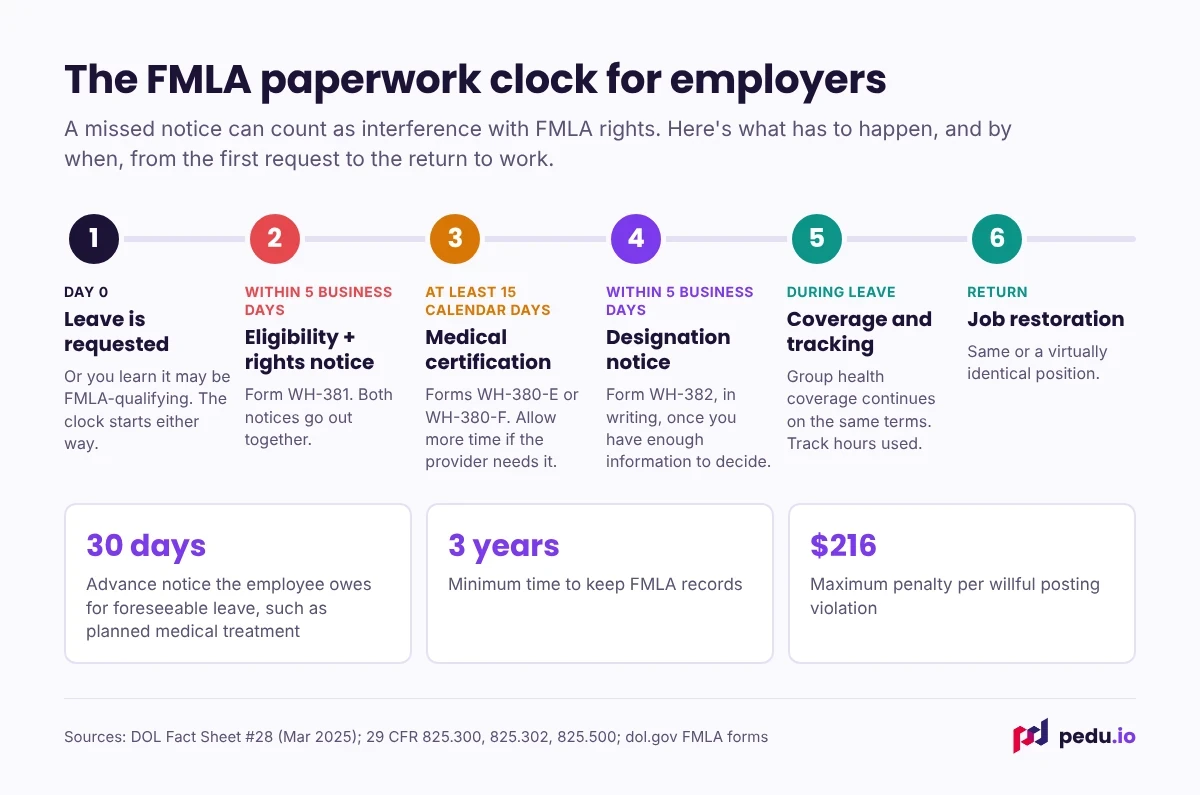
- General notice. Post the FMLA poster where employees and applicants can see it. Electronic posting can satisfy the rule. If you have any eligible employees, also put the notice in your handbook or give a copy to each new hire. A willful failure to post can bring a penalty of up to $216 per separate offense.
- Eligibility notice. Within five business days of a leave request, or of learning that the leave may be FMLA-qualifying, tell the employee whether they’re eligible. The employee doesn’t have to say "FMLA" for the clock to start.
- Rights and responsibilities notice. Send it with every eligibility notice. It spells out what you expect, such as medical certification and how paid leave and premium payments will work, and what happens if the employee doesn’t meet those expectations. DOL’s form WH-381 covers both this notice and the eligibility notice.
- Designation notice. Within five business days of having enough information to decide (usually once the medical certification comes back), tell the employee in writing whether the leave is designated as FMLA leave. DOL’s form is WH-382.
Getting these wrong isn’t just a paperwork slip. Failing to follow the notice rules can count as interference with FMLA rights, and an employee can recover lost pay and benefits, other direct monetary losses, and remedies such as reinstatement.
FMLA forms employers use
The Department of Labor publishes optional forms. You can use your own versions if they cover the same basic information.
- WH-380-E: certification of the employee’s own serious health condition.
- WH-380-F: certification of a family member’s serious health condition.
- WH-381: eligibility notice and rights and responsibilities notice.
- WH-382: designation notice.
- WH-384: certification of a qualifying exigency for military family leave.
- WH-385: certification for military caregiver leave for a current servicemember.
- WH-385-V: certification for military caregiver leave for a veteran.
The FMLA poster itself is the general notice.
Medical certification
You can ask for a certification from the health care provider. The employee must get at least 15 calendar days to return it, and more if they can’t get it in time despite real effort. Don’t designate or deny based on a guess while the certification is still out. Wait for it, then send the designation notice within five business days.
Intermittent leave and reduced schedules
Employees can take FMLA leave all at once or, when medically necessary, in separate blocks of time or on a reduced schedule. Leave to bond with a new child is different: it can be taken intermittently only if you agree.
Intermittent leave is where tracking breaks down. Record each absence against the employee’s 12-week entitlement as it’s used, so you always know what’s left.
Employee notice
When leave is foreseeable, such as an expected birth, an adoption or foster placement, or planned medical treatment, the employee must give at least 30 days’ notice. When that isn’t practicable, they must give notice as soon as practicable, which generally means the same day or the next business day after they learn they need leave.
Health benefits, job restoration and retaliation
- Health coverage: keep the employee’s group health coverage on the same terms as if they were working.
- Return to work: restore them to the same job or a virtually identical one.
- No negative factor: you can’t use FMLA leave against an employee in hiring, promotion or discipline decisions, and you can’t count it under a no-fault attendance policy.
Recordkeeping
- Keep FMLA records for at least three years.
- Keep medical certifications and other medical records confidential, in files separate from the personnel file.
- Supervisors can be told about necessary work restrictions and accommodations. The medical details stay in the confidential file.
An FMLA compliance checklist for HR
- Confirm you’re covered and post the general notice, including electronically for remote staff.
- Put the FMLA policy and your 12-month method in the handbook.
- Train managers to send leave requests to HR the same day, whether or not the employee says "FMLA."
- Diary five business days from every request for the eligibility and rights notices.
- Track the certification deadline and diary five business days from receipt for the designation notice.
- Track intermittent leave as it’s used.
- Keep health coverage running and plan the return to the same or an equivalent job.
- Remove FMLA absences from attendance points.
- File medical records separately and keep everything for three years.
How Pedu helps HR teams with FMLA
FMLA questions rarely arrive alone. A single injury can raise FMLA, ADA and workers’ comp issues at once. Pedu’s recorded sessions on leave law are taught by practitioners and come with SHRM and HRCI credit.
Start with The FMLA: An Employer’s Guide to Compliance, a 60-minute session with compliance consultant Suzanne Lucas. For abuse and overlap cases, 2026 Leave Red Flags: Addressing Abuse Under FMLA, ADA & Workers’ Comp runs 90 minutes. You can also browse the full recorded library or the live webinar schedule. Questions? Email [email protected].
Frequently asked questions
What are the FMLA rules for employers?
Covered employers must give eligible employees up to 12 workweeks of unpaid, job-protected leave in a 12-month period for qualifying reasons (26 workweeks for military caregiver leave), keep their group health coverage, restore them to the same or an equivalent job, give the required notices on time and keep records for three years.
How many employees do you need for FMLA to apply?
For private employers, 50 or more employees in 20 or more workweeks in the current or previous calendar year. Public agencies and public and private elementary and secondary schools are covered regardless of size. Separately, an employee is only eligible if you have 50 employees within 75 miles of their worksite.
Who is eligible for FMLA leave?
An employee who has worked for you for at least 12 months, has at least 1,250 hours in the 12 months before the leave, and works at a location with at least 50 employees within 75 miles.
Is FMLA leave paid?
No. FMLA leave is unpaid, but employees can use their paid leave at the same time, and employers can require them to.
How long does an employer have to respond to an FMLA request?
Five business days to send the eligibility notice and the rights and responsibilities notice, and five business days to send the written designation notice once you have enough information to decide.
What FMLA forms does an employer need?
The DOL’s optional forms are WH-380-E and WH-380-F for medical certification, WH-381 for the eligibility and rights notices, WH-382 for designation, and WH-384, WH-385 and WH-385-V for military family leave. You also need the FMLA poster.
What is intermittent FMLA?
FMLA leave taken in separate blocks of time or on a reduced schedule, rather than all at once. It’s available when medically necessary. For bonding with a new child, it needs the employer’s agreement.
How long does an employee have to return a medical certification?
At least 15 calendar days, and longer if they can’t get it in time despite diligent, good-faith efforts.
Can an employer count FMLA absences under an attendance policy?
No. FMLA leave can’t be used as a negative factor in employment actions, and it can’t be counted under a no-fault attendance policy.
How long must FMLA records be kept?
At least three years. Medical records must be kept confidential and separate from personnel files.
Sources
- U.S. Department of Labor, Fact Sheet #28: The Family and Medical Leave Act (revised March 2025)
- U.S. Department of Labor: FMLA forms
- 29 CFR 825.300: employer notice requirements
- 29 CFR 825.302: employee notice for foreseeable leave
- 29 CFR 825.200: amount of leave and the 12-month period
- 29 CFR 825.220: protection for employees who request or take leave
- 29 CFR 825.500: recordkeeping requirements