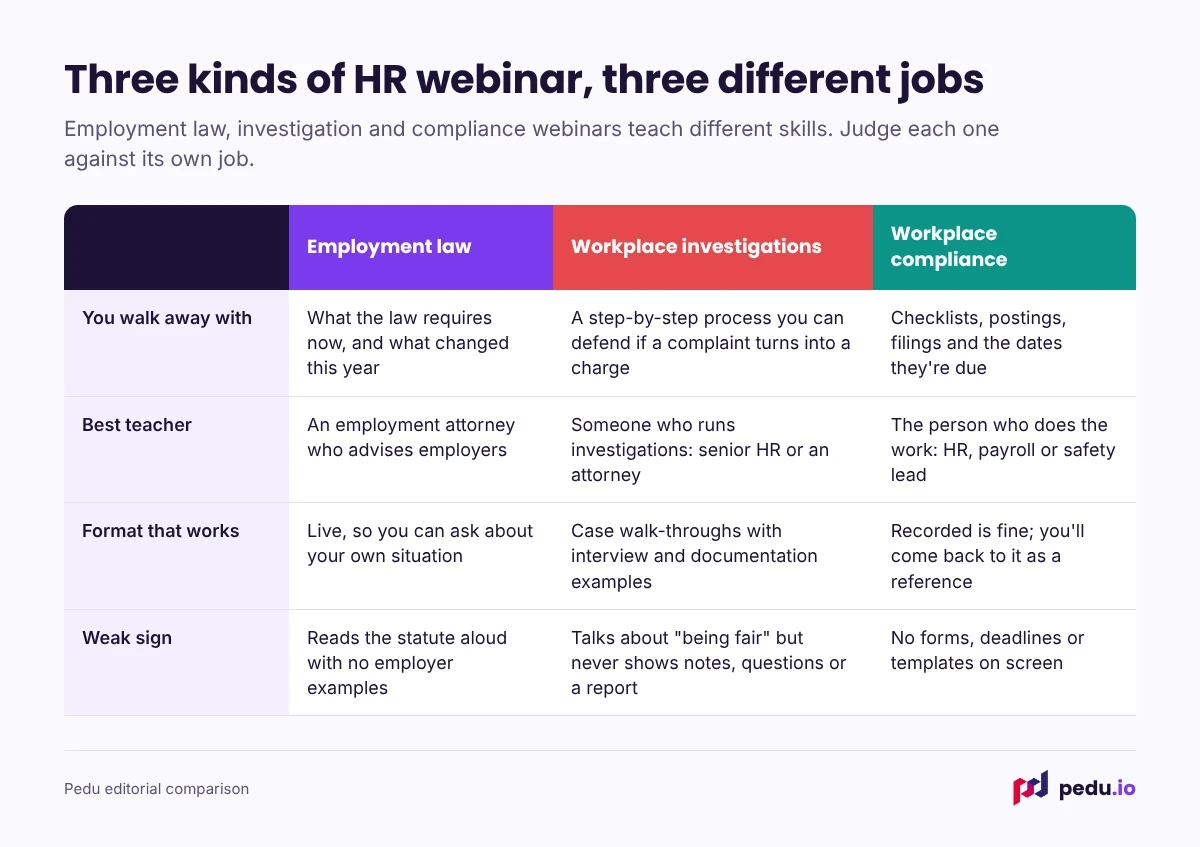
Short answer: Employment law, workplace investigation and workplace compliance webinars look alike on a catalog page, but they teach three different jobs. Employment law sessions explain what the law requires. Investigation sessions teach you how to handle a complaint so the outcome holds up. Compliance sessions cover the filings, postings and deadlines. Judge each one against its own job, and pick the teacher to match.
Why these three get lumped together
Open any HR webinar catalog and you’ll see them side by side: "FMLA Updates for 2026", "Conducting a Harassment Investigation", "OSHA Recordkeeping Made Simple". All three carry SHRM PDCs or HRCI credit, and all three run 60 to 90 minutes. So it’s easy to treat them as interchangeable credit hours.
They aren’t. A good employment law session leaves you knowing the rule. A good investigation session leaves you able to run an interview on Monday. A good compliance session leaves you with a dated checklist. If you buy one expecting what another delivers, you’ll finish the hour with your credit and without what you needed.
Employment law webinars: knowing the rules
These sessions cover the statutes, regulations and court decisions that shape employment decisions: wage and hour law, leave, discrimination, accommodation, employee handbooks and the like.
What a strong one gives you:
- What changed, when it takes effect and which employers it covers
- How the rule plays out in real employer situations, not just the statute text
- Where federal law stops and state law takes over
- The two or three decisions you need to revisit in your own policies
Who should teach it: an employment attorney who advises employers, or an HR practitioner who works closely with counsel. The attorney matters most when the topic is new or contested, because they can tell you how agencies and courts are actually reading the rule.
Best format: live. Employment law questions are rarely generic. "Does this apply to our two remote workers in Colorado?" is exactly the kind of thing you want to ask in the Q&A.
Warning sign: the speaker reads the statute aloud and never says "here’s what this means for you as an employer".
Workplace investigation webinars: handling the complaint
Investigation training is about process. Someone reports harassment, discrimination or retaliation, and HR has to find out what happened in a way that’s fair, documented and defensible if the complaint later becomes an agency charge or a lawsuit.
What a strong one gives you:
- When to investigate, and when to bring in an outside investigator
- How to plan interviews, what to ask and what never to ask
- How to document as you go, so your notes don’t become the employer’s problem
- How to reach and write up a finding, and how to protect against retaliation afterward
Who should teach it: someone who has actually run investigations. That could be a senior HR professional (SPHR or SHRM-SCP) with years of employee-relations work, or an attorney who conducts or reviews workplace investigations.
Best format: case-based. The best sessions walk through a realistic complaint from intake to final report and show sample interview questions and notes. Live sessions add value because attendees ask about the messy cases: the witness who won’t talk, the complaint against a senior leader.
Warning sign: plenty of talk about "being fair and objective" and no sample questions, notes or report.
Workplace compliance webinars: getting the paperwork right
Compliance training is the operational side: what you must file, post, record or keep, and by when. Think OSHA injury logs, Form I-9, payroll tax forms, EEO-1 reporting, required workplace posters and record retention.
What a strong one gives you:
- The forms, the deadlines and who is covered
- Common errors that trigger penalties or audit findings
- A checklist or template you can use the same day
Who should teach it: the person who does the work. A payroll professional for payroll forms, a safety or HR lead for OSHA recordkeeping, an HR operations specialist for I-9.
Best format: recorded works well here. These rules change less often, and you’ll come back to the session as a reference when the deadline arrives.
Warning sign: no actual forms, dates or templates on screen.
Which one do you need first?
Start from the problem in front of you, not from the catalog.
- A complaint just landed on your desk. Take an investigation session now, even a recorded one. Process mistakes in the first week are the hardest to undo.
- A law changed and your handbook hasn’t. Take a live employment law session, ideally one that covers your states.
- A filing deadline is six weeks out. Take a compliance session now, while there’s time to fix what you find.
- You’re new to an HR generalist role. Do one of each in your first quarter. You’ll learn the rules, the process and the paperwork in that order.
Managers are a separate case. They rarely need a full employment law webinar, but they do need to know what to do when an employee raises a complaint. Several states, including California, New York and Illinois, require harassment prevention training for employees and supervisors. A short investigation-awareness session for managers prevents more problems than an hour on statute text.
Do all three earn SHRM and HRCI credit?
Usually, yes, as long as a SHRM Recertification Provider or an HRCI Approved Provider runs the session. The credit math is the same for all three:
- SHRM: 60 minutes of education earns 1 PDC under Advance Your Education, the one SHRM category with no cap.
- HRCI: 60 minutes earns 1 credit, usually HR (General). A session that covers business strategy may be approved for Business credit instead, which SPHR holders need 15 of.
So a 90-minute investigation webinar earns the same 1.5 credits as a 90-minute employment law update. The difference is what you can do afterward.
A simple mix for the year
If you earn roughly 20 credits a year to stay on pace for a 60-credit cycle, a sensible split looks like this:
- Employment law updates, about 40% of your hours. The rules move every year, and so do your states.
- Workplace compliance, about 40%. Deadlines repeat yearly, and errors cost real money.
- Investigations, about 20%. One solid session, refreshed every year or two, covers most HR teams.
Adjust it to your role. An employee-relations specialist should flip it and spend more time on investigations. A payroll-heavy HR team will lean toward compliance.
Where Pedu fits
Pedu runs all three kinds of session, taught by people who do this work. For example, investigation topics such as EEOC harassment and discrimination claims are taught by Diane L. Dee (SPHR, SHRM-SCP). Employment law sessions include attorneys such as Janette S. Levey, Esq., and compliance sessions include OSHA recordkeeping with Matthew Burr. Every credit-eligible session carries SHRM PDCs and HRCI credit, and if you miss the live time, the recording lands in your Pedu account within 24 hours.
Browse the live webinars for upcoming sessions, or the recorded sessions if you need something today. You can also see each instructor’s background on the speakers page.
Frequently asked questions
What is the difference between employment law training and compliance training?
Employment law training explains what the law requires and how courts and agencies read it. Compliance training covers the operational follow-through: the forms, postings, records and deadlines that prove you met those rules. You need the first to make good decisions and the second to document them.
What should workplace investigation training cover?
It should cover when to open an investigation, how to plan and run interviews, what to ask and avoid, how to document as you go, how to weigh evidence and reach a finding, how to write the report, and how to prevent retaliation afterward. Look for sample questions and a sample report, not just principles.
Who should attend a workplace investigation webinar?
HR generalists, HR business partners and employee-relations staff who take complaints. Managers benefit from a shorter version that teaches them what to do in the first 24 hours after a complaint: listen, don’t promise confidentiality you can’t keep, and hand it to HR.
Is a webinar enough to prepare me to run workplace investigations?
It’s enough to run straightforward ones with a sound process. It isn’t a substitute for experience on complex cases. Pair the webinar with a template, have a senior colleague review your first few reports, and refresh the training every year or two.
When should HR use an outside investigator instead of investigating internally?
Consider an outside investigator when the complaint involves a senior leader, when HR itself is involved or conflicted, when the allegations are severe, or when litigation looks likely. An independent investigator, often an attorney, makes the findings harder to challenge.
How often should HR professionals take employment law training?
At least once a year for a general update, plus a focused session whenever a major rule changes in a state where you have employees. Remote work has made the state piece bigger: one new hire in a new state can bring a new set of leave, pay and posting rules.
Do employment law webinars count toward SHRM and HRCI recertification?
Yes, when a SHRM Recertification Provider or an HRCI Approved Provider runs them. SHRM counts them under Advance Your Education at 1 PDC per hour. HRCI usually counts them as HR (General) credit at 1 credit per hour.
Are recorded employment law webinars still useful months later?
For the core rules, yes. For anything labeled an "update", check the recording date first. A session recorded before a rule changed can still earn credit, but it may teach you something that’s no longer true.
Do managers need employment law training or investigation training?
Most managers need a short course in both, weighted toward what to do when an employee complains. Several states, including California, New York and Illinois, require harassment prevention training that covers supervisors. Full statute-level employment law training is for HR.
How long should an HR compliance webinar be?
60 minutes is enough for one form or one deadline. 90 minutes suits a topic with several moving parts, like multistate payroll tax or FMLA and ADA together. Anything that runs longer should include worked examples, not just more slides.
Sources