Short answer: When your HRCI deadline is close, work in this order: find your exact gap (total credits plus any Business, Global, California or Ethics credits you still owe), use free pre-approved webinars and anything you’ve already earned but not logged, then buy the rest where each credit costs least, usually longer sessions or an unlimited pass. If you can’t make it, HRCI gives you up to 12 months in suspended status to finish, for a $100 fee on top of the regular $169.
Step 1: Find your real gap
Log in to your HRCI account and check two numbers before you spend anything.
Your cycle end date. HRCI cycles run three years and end on the last day of your birth month in the third year. Your account shows the exact date.
What you still owe, by type. The total is only half of it:
- aPHR and aPHRi: 45 credits per cycle, no specified credits.
- PHR and PHRi: 60 credits, no specified credits.
- PHRca: 60 credits, including 15 California credits.
- SPHR and SPHRi: 60 credits, including 15 Business credits.
- GPHR: 60 credits, including 15 Global credits.
Every credential also needs at least one ethics-themed activity, which counts toward the total. If you’re an SPHR with 50 credits logged but only 6 of them Business, you don’t need 10 more of anything. You need 9 Business credits and 1 more of any type, and buying 10 cheap General credits won’t fix it.
Step 2: Use the free and forgotten credits first
Credits you’ve earned but not logged. Look back through your cycle for conference sessions, employer training, a presentation you gave or an HR project you led. HRCI accepts several of these, including self-reported continuing education tied to its Exam Content Outline. Logging them costs nothing.
Free pre-approved webinars. A few sources offer HRCI credit at no cost or close to it:
- HRCI’s own webcasts show an Activity ID in or near the presentation. Take a screenshot before you close it, because HRCI doesn’t send separate proof. Prices for HRCI’s learning resources vary, and some are low-cost.
- E-Verify runs free Form I-9 and E-Verify webinars eligible for HRCI credit.
- Some payroll software companies, such as Patriot Software, give HRCI credit for live attendance at their free payroll webinars.
Free sessions are narrow in topic and fixed in time, so they rarely close a big gap alone. They’re worth a few credits.
Step 3: Buy the rest at the lowest cost per credit
This is where most people overspend. Three rules help:
- Buy by the credit, not the session. A 90-minute webinar earns 1.5 credits for roughly the price of a 60-minute one. At $199, that’s $132.67 per credit instead of $199.
- Match the credit type. If you need Business credits, check that each session you buy is approved as Business before you pay.
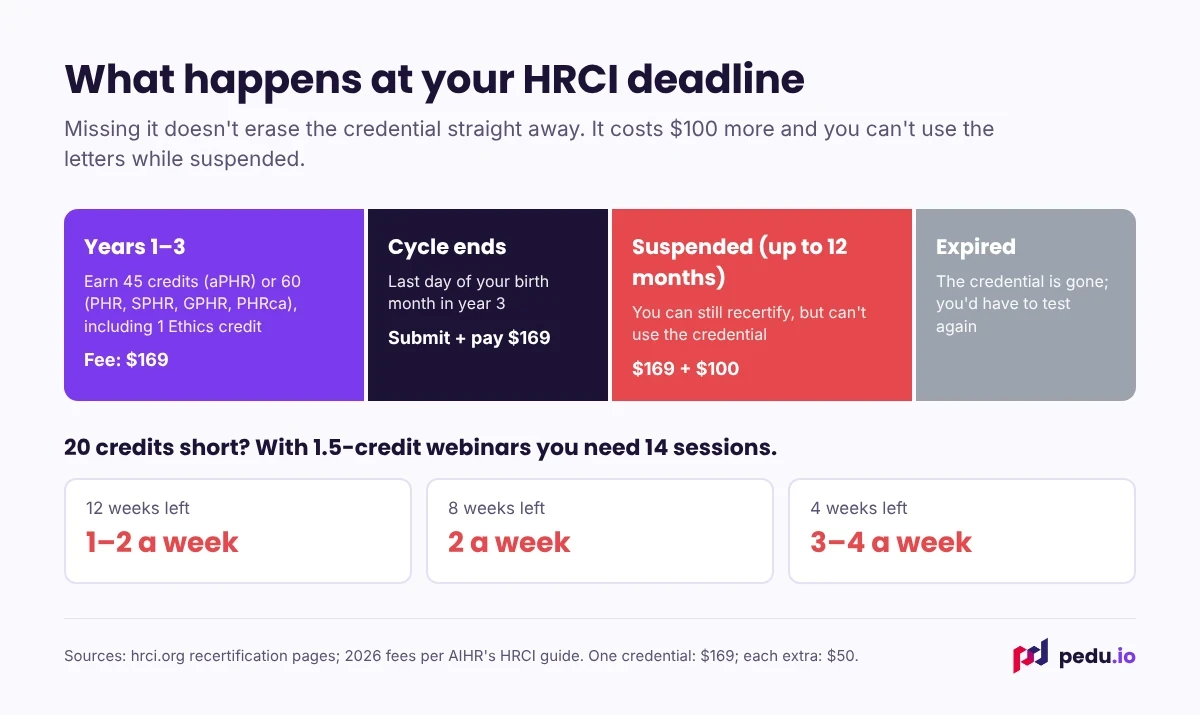
- Do the plan math. If your gap is 20 credits, that’s about 14 sessions of 1.5 credits. Buying 14 singles costs $2,786. An unlimited pass at $999 covers all of them, about $50 per credit.
Step 4: Know what happens if you miss the date
Missing your end date doesn’t wipe out the credential straight away. It moves to suspended status:
- You have up to 12 months to finish and submit.
- You pay a $100 suspension fee in addition to the regular recertification fee.
- You can’t use the credential while it’s suspended, and HRCI can’t verify it for employers.
- The time you spend suspended comes out of your next cycle. Your cycle dates don’t move.
After the suspension window closes, the credential expires. If it’s a requirement for your job, finishing on time is worth more than the $100.
A four-week sprint
If you have a month and a 20-credit gap, here’s a realistic plan:
- Week 1: log forgotten credits, watch 2 free webinars and buy your plan (3 to 5 credits).
- Week 2: 4 recorded sessions of 1.5 credits, prioritizing any specified credits you owe (6 credits).
- Week 3: 4 more recorded sessions, including an ethics-themed one if you still need it (6 credits).
- Week 4: 2 or 3 sessions to close the gap, then submit and pay (3 to 4.5 credits).
Three or four sessions a week is a lot alongside a full-time job. If you have eight weeks, two a week is comfortable.
Fees at a glance
As of 2026, recertifying one HRCI credential costs $169, and each additional credential recertified at the same time costs $50. The suspension fee is $100 on top. Check your HRCI account for the amount that applies to you before you pay.
How Pedu helps when time is short
Pedu is an HRCI Approved Provider. Every credit-eligible session comes with HRCI credit and an Activity ID on your certificate, and the recorded library is available immediately, so you can start tonight instead of waiting for the next live date. Most sessions run 60 to 90 minutes, and some run 120.
Start with the recorded sessions, compare the pricing plans, and use our HRCI recertification credits guide to confirm your requirements. PHR and SPHR holders can also read our PHR and SPHR page.
Frequently asked questions
When is my HRCI recertification deadline?
At the end of your three-year cycle, on the last day of your birth month in the third year. Your HRCI account shows the exact date and how many credits you’ve logged so far.
What happens if I miss my HRCI recertification deadline?
Your credential moves to suspended status. You then have up to 12 months to complete and submit your recertification, with a $100 fee on top of the regular fee. You can’t use the credential while it’s suspended, and the suspended time comes out of your next cycle.
How much does HRCI recertification cost in 2026?
$169 to recertify one credential, plus $50 for each additional credential recertified at the same time. If your credential is suspended, add the $100 suspension fee.
Can I earn HRCI credits for free?
Yes, a few. E-Verify’s free webinars are eligible for HRCI credit, some payroll and HR software companies give credit for live attendance at their free webinars, and some HR membership sites offer pre-approved webcasts with a free account. HRCI’s own webcasts also carry Activity IDs, though prices vary. Free options rarely cover a large gap, but they help.
Do I have to earn HRCI credits evenly across the three years?
No. HRCI has no yearly minimum, so you can earn most of your credits late in the cycle. It’s riskier, though: the closer you get to the deadline, the fewer sessions fit your schedule and your specified credit types.
Can extra HRCI credits roll over to my next cycle?
Yes, within limits. HRCI lets active certificants carry over surplus credits submitted in addition to the required total. AIHR’s 2026 summary puts the cap at 15 credits, earned in the last 12 months of the cycle. Check your HRCI account for the current rule.
Does the HRCI ethics credit need a special course?
It needs to be an ethics-themed activity, such as a webinar on HR ethics or ethical decision-making. It counts toward your 45 or 60 total, not on top of it. One per cycle is enough.
I’m an SPHR and short on Business credits. What counts?
Activities approved as Business credit, which cover the strategy and business-management side of HR: workforce planning, finance for HR, organizational strategy and similar topics. Check the credit type on each session before you buy; General credits won’t fill the Business gap.
How do I make sure my credits show up before I apply?
Enter each Activity ID in your HRCI account as you finish the session and upload the certificate at the same time. HRCI doesn’t review your activities until you submit the application and pay, so a complete record avoids last-minute surprises.
Sources
- HRCI: submitting your recertification application (suspension and $100 fee)
- HRCI: recertify by provider (Activity IDs and webcasts)
- AIHR: HRCI recertification guide, 2026 edition (fees, cycle dates, carry-over)
- myCPE: HRCI recertification credit requirements
- Patriot Software: HRCI and SHRM credits for live webinars