Short answer: HRCI-credit webinars on payroll and employment law come from specialist HR and payroll compliance providers, payroll software companies, employment law firms and, for Form I-9, E-Verify. The credit counts the same as any other HR (General) credit, as long as the session is pre-approved. What separates a good one is the teacher: payroll and payroll tax topics should be taught by a CPP or an Enrolled Agent, and employment law topics by an attorney or a senior HR practitioner who works with counsel.
Why HR should spend credit hours on payroll and employment law
In most small and mid-sized companies, HR and payroll sit side by side, and their mistakes land on each other. A misclassified role becomes an overtime claim. A remote hire in a new state becomes a withholding problem. A leave case handled by the book in HR becomes a pay error in payroll.
These topics also change often. Payroll tax rules shift with almost every tax year, and employment law moves at federal, state and city level at once. That makes them good uses of credit hours: you’d need to learn them anyway, and the credit comes with it.
Topics that are worth the credit
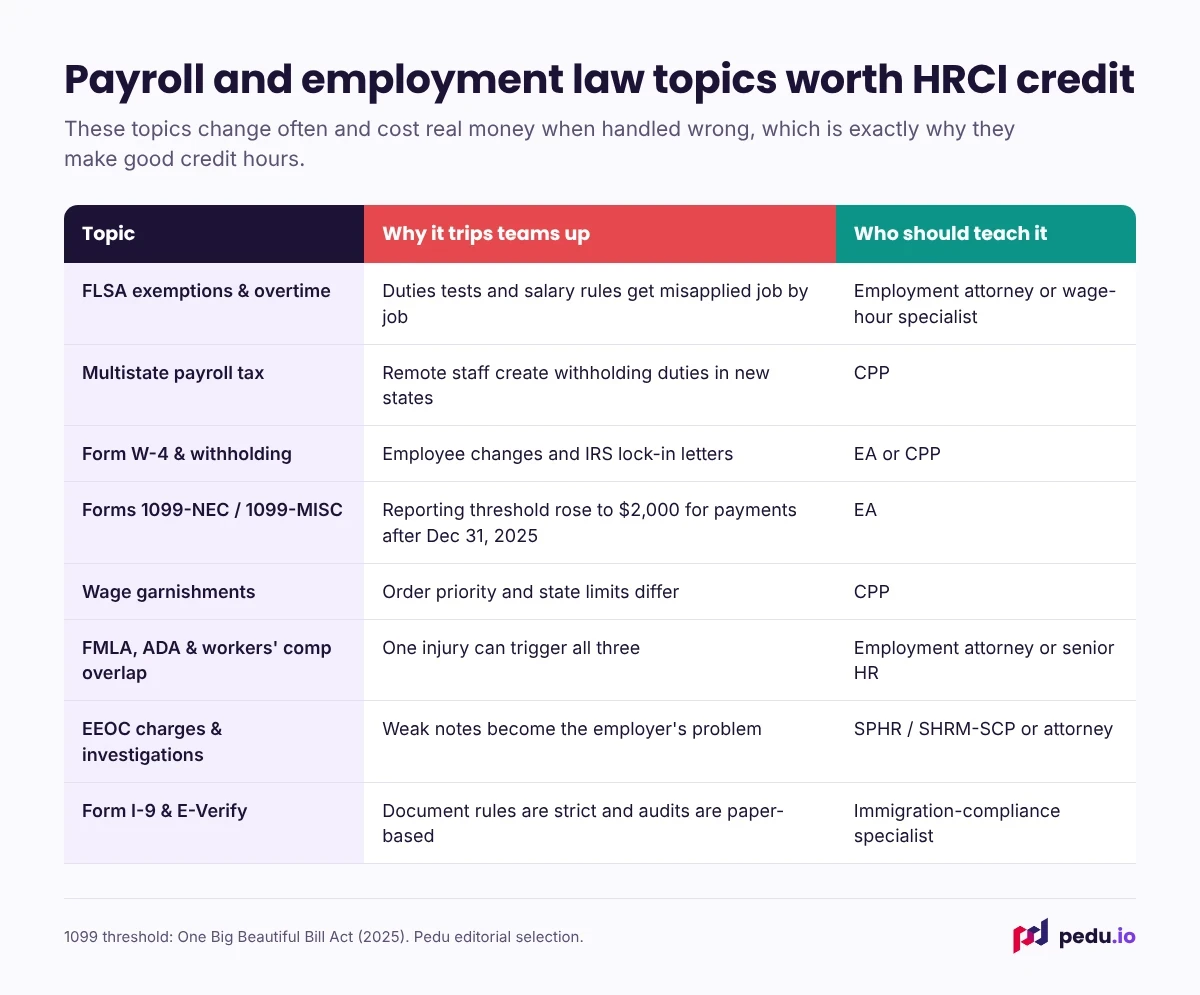
A few deserve extra attention right now:
- Forms 1099-NEC and 1099-MISC. The One Big Beautiful Bill Act raised the reporting threshold from $600 to $2,000 for payments made after December 31, 2025. If your company pays contractors, someone needs to know exactly which payments still need a form.
- Multistate payroll tax. Remote and hybrid work means more employers withhold in states where they have no office. Reciprocity agreements, resident versus work-state rules and local taxes trip up even experienced teams.
- Form W-4 and withholding. Employees change W-4s more often than most HR teams expect, and IRS lock-in letters override what the employee chose.
- FLSA exemptions and overtime. Job titles don’t decide exempt status; duties and salary do. A session that walks through real job descriptions is worth more than one that reads the tests aloud.
- FMLA, ADA and workers’ comp overlap. One injury can trigger all three, each with its own notices and timelines.
Where to look
Specialist HR and payroll compliance providers
Training companies focused on HR and payroll compliance run the widest range of these topics, usually with both SHRM and HRCI approval. They’re the most efficient source if you want several sessions a year from the same speaker roster.
Payroll software companies
Some payroll software companies run free webinars with credit. Patriot Software, for example, has offered 1 CPE credit, 1 HRCI credit and 1 SHRM credit for live attendees of eligible payroll sessions. Expect a short product mention and a basic-to-intermediate level.
Payroll associations
Payroll associations such as PayrollOrg focus on payroll professionals and their own certifications. Their training is deep and accurate; check each program for HRCI approval before counting on the credit.
Employment law firms
Many firms run free client webinars on new laws and court decisions, and some get them approved for HRCI credit. They’re the best source for "what changed and what’s the risk", and lighter on payroll mechanics.
E-Verify
For Form I-9 and E-Verify, the agency’s own free webinars are eligible for HRCI credit and come straight from the source.
How to tell a payroll expert from a generalist
Read the session description and speaker bio for these signs:
- The credential matches. CPP for payroll operations, EA or CPP for payroll tax, attorney for employment law.
- The description names specifics. "Supplemental wage withholding", "reciprocity agreements" or "lock-in letters" signal someone who does the work. "Payroll best practices" signals someone who doesn’t.
- The speaker works on it now. Payroll tax knowledge from five years ago is out of date.
- There’s a worked example. Good payroll sessions walk through a real pay calculation or a filled-in form.
What credit to expect
Most payroll and employment law webinars are approved as HR (General) credit at one credit per hour, so a 90-minute session earns 1.5. They rarely carry Business credit, so SPHR and SPHRi holders should plan their 15 Business credits separately. The same sessions often carry SHRM PDCs too.
Pedu’s payroll and employment law sessions
Pedu’s catalog leans heavily toward these topics, taught by specialists. Recent sessions include:
- Multistate Employee Taxation in 2026: Rules, Risks & Best Practices with Vicki M. Lambert, CPP (90 minutes)
- Form W-4 Essentials: Ensuring Accurate Employee Withholdings in 2026 with Patrick A. Haggerty, EA (90 minutes)
- Preparing Forms 1099-MISC & 1099-NEC for 2026 with Patrick A. Haggerty, EA (120 minutes)
- 2026 Leave Red Flags: Addressing Abuse Under FMLA, ADA & Workers’ Comp with Suzanne Lucas (90 minutes)
- EEOC Claims in 2026: Investigating Harassment & Discrimination with Diane L. Dee, SPHR, SHRM-SCP (90 minutes)
Each credit-eligible session carries HRCI credit and SHRM PDCs, live or recorded. Browse the recorded sessions and live webinars, or read the speakers’ backgrounds on the speakers page.
For the HRCI rules behind these credits, see our HRCI recertification credits guide.
Frequently asked questions
Do payroll webinars count toward HRCI recertification?
Yes, when the session is pre-approved by HRCI and has an Activity ID. Payroll is part of HR’s compensation and compliance responsibilities, so pre-approved payroll sessions usually count as HR (General) credit.
Which payroll topics should HR professionals understand?
At minimum: exempt and non-exempt classification, overtime, Form W-4 withholding, final pay rules in your states, wage garnishments, Forms W-2 and 1099, and how leave affects pay. If you have remote staff, add multistate payroll tax.
Do I need to be a CPP to follow a payroll compliance webinar?
No. Most HR-focused payroll webinars are pitched at HR generalists and managers. The speaker should be the specialist; you don’t need to be. Look for sessions described as practical or intermediate rather than advanced.
Why is multistate payroll tax such a common webinar topic now?
Because remote and hybrid work spread employees across states. An employer can owe withholding, unemployment tax and registrations in a state where it has no office, and the rules on where an employee is taxed vary by state and sometimes by city.
What is an IRS lock-in letter?
It’s an IRS notice telling an employer to withhold federal income tax from a specific employee at a set level, because the employee’s Form W-4 was leading to too little withholding. The employer must follow it, even if the employee later submits a new W-4.
What is the difference between exempt and non-exempt employees?
Under federal law, exempt employees meet both a duties test and a salary test and aren’t owed overtime. Non-exempt employees must receive overtime at one and a half times their regular rate for hours over 40 in a workweek. Many states add stricter rules.
Are employment law webinars from law firms approved for HRCI credit?
Some are. Firms that run regular client webinars often apply for HRCI approval, and the invitation will show the HRCI statement and credit hours. If it doesn’t, the session may still be self-reportable, but don’t count on it.
How many payroll webinars should an HR generalist take each year?
Two or three is a sensible minimum: one on year-end payroll and information returns, one on wage and hour or classification, and one on whatever your company changed this year, such as a new state or a new pay structure.