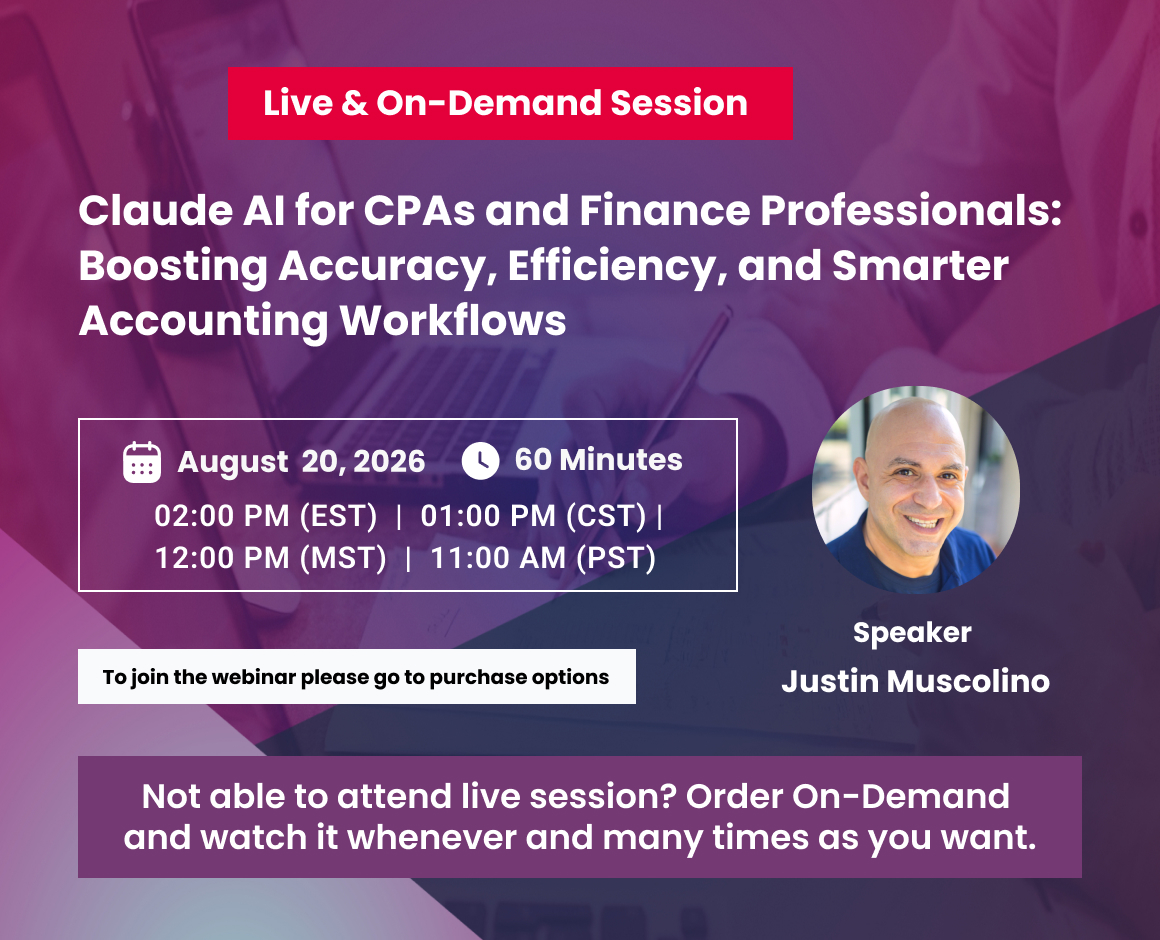
Claude AI for CPAs and Finance Professionals: Boosting Accuracy, Efficiency, and Smarter Accounting Workflows
"Not able to attend the live webinar? Purchase the recorded session and watch it at your convenience"
"The recording is added to your account within 24 hours of the live session, and we will email you when it is ready."
Webinar Overview
Webinar Overview
Artificial intelligence is reshaping the accounting profession, and Claude AI has emerged as one of the most powerful tools for finance and accounting professionals who need reliable document analysis, structured reasoning, and high-quality written communication.
Today’s CPAs, accountants, controllers, and finance teams face increasing pressure to process larger volumes of financial information, meet tighter reporting deadlines, maintain detailed documentation, and provide strategic business insights. Claude AI helps professionals streamline these responsibilities by assisting with research, financial analysis, document summarization, workflow organization, and professional writing—allowing teams to spend less time on repetitive administrative work and more time applying their expertise.
This practical 2026 training demonstrates how Claude AI can be integrated into everyday accounting workflows while maintaining professional judgment, confidentiality, and compliance standards. Participants will learn how to use Claude to summarize accounting guidance, draft internal memoranda, organize reconciliations, explain complex financial information, prepare variance analyses, improve documentation, and support month-end close and financial reporting activities.
The session also explores the limitations of generative AI, common mistakes that can affect financial accuracy, and best practices for reviewing AI-generated content before it becomes part of an organization’s accounting records or decision-making process.
Whether you work in public accounting, corporate finance, advisory services, or nonprofit organizations, this webinar provides practical techniques that can immediately improve productivity while preserving the accuracy and professional standards expected in today’s accounting environment.
Learning Objectives
By attending this webinar, participants will learn how to:
- Understand Claude AI’s capabilities and its role in modern accounting and finance.
- Incorporate AI into daily accounting workflows without replacing professional judgment.
- Summarize accounting standards, technical guidance, and financial documents efficiently.
- Draft accounting memoranda, reconciliation explanations, and internal documentation.
- Prepare clearer variance analyses and financial commentary.
- Organize accounting research, supporting documentation, and workflow tasks.
- Improve month-end close, reporting, and documentation processes using AI.
- Write more effective prompts that produce reliable and relevant accounting outputs.
- Recognize AI limitations, reduce inaccuracies, and validate AI-generated content.
- Maintain confidentiality, data security, and professional responsibility when using AI.
Areas Covered
- Introduction to Claude AI for accounting and finance professionals
- Practical AI use cases across accounting workflows
- Financial document review and intelligent summarization
- Drafting accounting memos and technical explanations
- Reconciliations, variance analysis, and financial reporting support
- Month-end close and reporting workflow optimization
- Accounting research and documentation techniques
- Prompt engineering strategies for accounting professionals
- AI risks, limitations, and quality control
- Confidentiality, governance, and responsible AI practices
Why You Should Attend
Accounting professionals who understand how to work effectively with AI will be better equipped to manage growing workloads, improve documentation quality, and deliver greater value to their organizations.
Rather than replacing accountants, Claude AI serves as a productivity assistant that helps reduce repetitive work, accelerate research, organize information, and improve written communication— allowing professionals to focus on analysis, critical thinking, and informed decision-making.
This webinar provides practical demonstrations, real-world accounting examples, and immediately applicable techniques that participants can use to enhance productivity while maintaining the accuracy, integrity, and professional standards expected in today’s accounting environment.
Ask your question directly from our expert during the Q&A session following the live event.
Meet Your Instructor

Justin Muscolino
Compliance & AML/KYC Training Expert
Justin Muscolino is the CEO & Co-Founder of High-risk Education, where he helps companies build stronger compliance training programs. With over 20 years of experience—including roles at FINRA, JPMorgan Chase, UBS, and Macquarie —Justin brings a practical understanding of how to meet regulatory expectations while keeping training clear and useful. He’s worked with banks, fintechs, and other high-risk industries to improve how they train staff on rules, risks, and responsibilities.
Through High-risk Education, Justin focuses on simplifying complex topics like AML, KYC, and consumer protection. He’s led training initiatives around the world and works directly with clients to close compliance gaps and reduce risk. Known for being hands-on and results-driven, Justin also serves as an advisor and writer for several industry groups and continues to support organizations in building a culture of accountability.
Frequently Asked Questions
Sign up now on pedu.io to discover a wide range of webinars from industry specialists. Choose your preferred access type (‘Live Only’, ‘Live + Recorded Session’, or ‘Recorded Session Only’), and simply click on ‘Buy Now’ to get enrolled.
Yes. Eligible sessions are approved for SHRM PDCs and HRCI recertification credits. After you attend live (or finish the Recorded Session), we automatically email your certificate with the activity ID you can enter directly into your SHRM or HRCI portal.
After checkout, you will receive an instant confirmation along with a calendar invite. The actual join link will be emailed to your registered email address 24 hours before, and again 1 hour before the webinar begins.
Don’t worry! If you choose the “Live + Recorded Session” or “Recorded Session only” access option during checkout, the recording will land in your inbox automatically after the session concludes. It is saved in our cloud storage so you can watch it as many times as you want, anytime, from anywhere.
Yes. You can explore your industry with your colleagues. The 5–10 and 11+ team options cover a group on a single purchase, and everyone who attends can receive their own certificate.
Live-only access doesn’t include the replay. However, “Live + Recorded Session” and “Recorded Session only” do include unlimited cloud viewing. You can also add a downloadable MP4 video to keep forever at checkout. We offer soft-copy transcripts (comprehensive word-for-word documents) that can be bundled with your order so you never miss a detail.
Yes! At the end of each live webinar, we host a real-time Q&A session where you have the opportunity to interact with our industry experts and get answers to your specific queries.
Yes. If you miss a live webinar on Pedu, the recorded session is automatically added to your Pedu account after the webinar. Simply log in, open your registered webinar from the dashboard, and click Watch Recording to view it anytime.
Receive a 100% refund on any upcoming webinar if you cancel at least 48 hours before the scheduled start time.
Pack Of 5 Webinars
$599
/ 12 months- Attend any 5 live, recorded Session, or a mix of both
- 12-Month validity.
- Live webinar access
- Recorded Session
- SHRM & HRCI credit on every session
- Single-user license
Annual Unlimited Access Pass
MOST POPULAR$999
/ 12 months- Attend unlimited live, recorded Session, or a mix of both
- 12-Month validity.
- Live webinar access
- Recorded Session
- SHRM & HRCI credit on every session
- Single-user license
Pack Of 10 Webinars
$799
/ 12 months- Attend any 10 live, recorded Session, or a mix of both
- 12-Month validity.
- Live webinar access
- Recorded Session
- SHRM & HRCI credit on every session
- Single-user license
Our Customer Feedback
Read what our amazing customers have to say about us.
5,000+ professionals trained • SHRM & HRCI accredited • 14 expert instructors
Upcoming Webinars
Explore live and Recorded Session sessions presented by top industry experts.