Short answer: Every hour of an approved HR webinar earns the same SHRM PDC, so choose topics by what they protect you from. The best-value topics are the ones where a mistake is expensive and the rules keep changing: multistate payroll tax, state paid leave, pay transparency and AI in hiring. Next come the high-stakes basics worth refreshing every year: FLSA overtime and exemptions, Form I-9, harassment and discrimination investigations, and the FMLA and ADA overlap.
Same PDC, very different value
A 60-minute session on interviewing skills and a 60-minute session on multistate payroll withholding each earn 1 PDC. Both count under Advance Your Education, as long as the provider is a SHRM Recertification Provider and the content fits SHRM’s Body of Applied Skills and Knowledge (SHRM BASK).
But they don’t protect your organization equally. One wrong withholding setup can run for months before anyone notices, across every paycheck for that employee. That’s why topic choice is the real decision in recertification, not just finding enough hours.
How to rank topics
Ask two questions about any topic:
- What does it cost to get it wrong? Back pay, penalties, legal fees, an agency charge, an injured employee.
- How often do the rules change? If they change yearly, last year’s training is already out of date.
Plot topics on those two axes and the priorities sort themselves out.
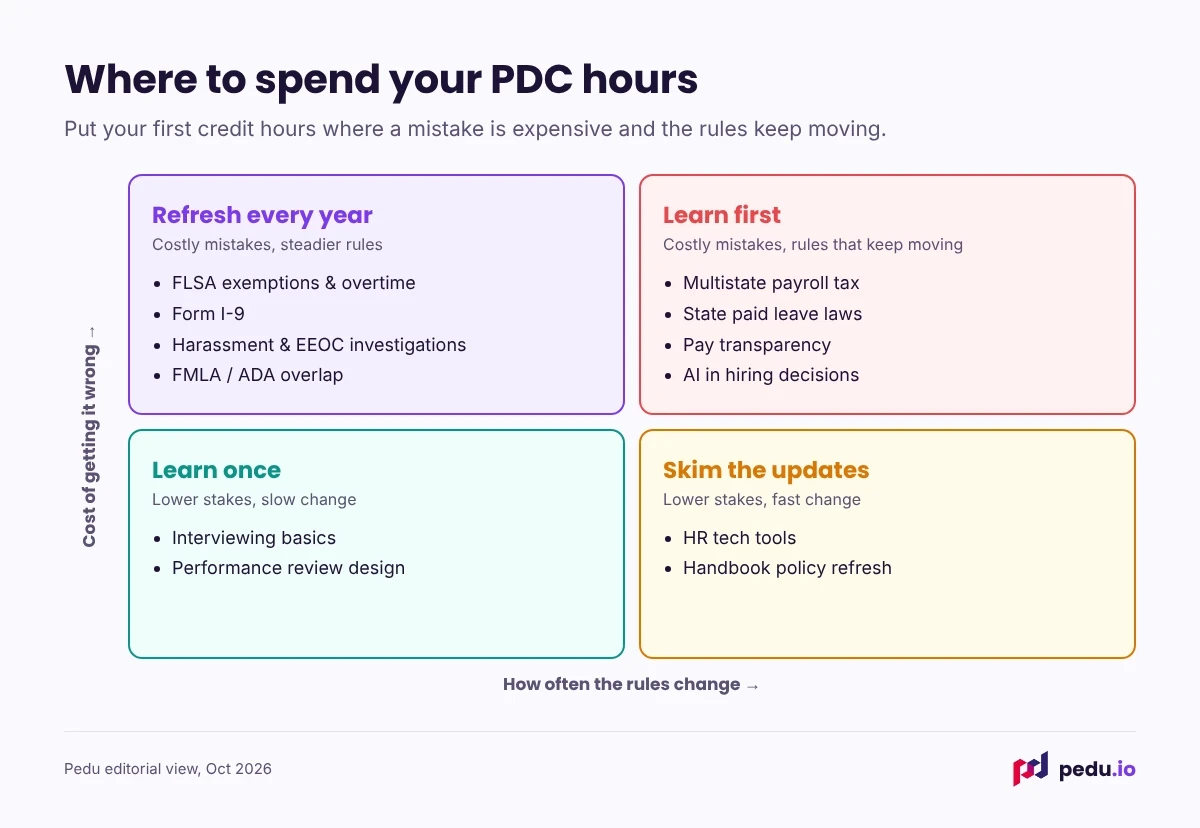
Learn first: costly mistakes, rules that keep moving
Multistate payroll tax. Remote work put employees in states where their employer has no office, and each state has its own withholding, unemployment and registration rules. Errors repeat every payroll until someone catches them.
State paid leave laws. A growing number of states and cities require paid sick or family leave, each with its own accrual, notice and pay rules. If you have employees in more than one state, this changes almost every year.
Pay transparency. Several states, including Colorado, California, Washington and New York, require salary ranges in job postings or on request, and more are following. A posting that’s compliant in one state may not be in another.
AI in hiring decisions. Automated screening tools are spreading faster than the rules about them. New York City already requires bias audits for automated employment decision tools, and other jurisdictions are writing their own rules.
Refresh every year: costly mistakes, steadier rules
FLSA exemptions and overtime. Misclassification is one of the most common and expensive wage and hour problems. The tests don’t change often, but job duties do.
Form I-9. The rules are strict and paper-based, and errors multiply across every hire. A yearly refresher catches drift before an audit does.
Harassment and EEOC investigations. How you handle a complaint often matters as much as the complaint itself. A refresher every year or two keeps your process defensible.
FMLA and ADA together. Each law is manageable alone. The overlap, especially with workers’ comp, is where HR teams get caught.
Skim the updates: lower stakes, fast change
HR technology and handbook refreshes change often, but a mistake is usually fixable. A short update session each year is enough.
Learn once: lower stakes, slow change
Interviewing skills and performance review design are worth learning well once, then revisiting only when your role changes.
Adjust for your organization’s size
Which laws apply depends partly on headcount, so your priorities should too. These are the main federal thresholds:
- 1 or more employees: Form I-9 and the Equal Pay Act; the FLSA for most employers
- 15 or more: Title VII and the ADA
- 20 or more: the ADEA (age discrimination) and COBRA
- 50 or more: the FMLA and the ACA employer mandate (50 full-time equivalents)
- 100 or more: EEO-1 reporting
Industry matters too. Manufacturing, construction and healthcare teams should add OSHA recordkeeping and safety topics near the top.
How to split your hours
A practical split for about 20 PDCs a year:
- 40% on "learn first" topics
- 35% on "refresh every year" topics
- 15% on "skim the updates"
- 10% on "learn once" topics, or on leadership and communication skills
Topics Pedu covers
Pedu’s sessions concentrate on the top half of the matrix: multistate payroll tax, W-4 withholding and Forms 1099, FMLA, ADA and workers’ comp, EEOC investigations, OSHA recordkeeping and handbook updates. Every credit-eligible session carries SHRM PDCs and HRCI credit, live or recorded.
Browse the live webinars and recorded sessions, or check your requirements on our SHRM recertification guide. Need a topic that isn’t on the schedule yet? Tell us at [email protected].
Frequently asked questions
Do all HR webinar topics qualify for SHRM PDCs?
No. To earn PDCs, a program has to align with SHRM’s Body of Applied Skills and Knowledge, which covers HR expertise and behavioral competencies. A webinar on general software skills, for example, may not qualify. Approved providers state the PDC amount on each session.
What is the SHRM BASK?
The SHRM Body of Applied Skills and Knowledge is the framework behind the SHRM-CP and SHRM-SCP. It covers HR knowledge areas, such as employment law and total rewards, and behavioral competencies, such as communication and leadership. Recertification activities must connect to it.
Do soft-skill webinars earn SHRM PDCs?
Yes, when they’re approved by a SHRM Recertification Provider. Communication, leadership and relationship management are part of the SHRM BASK. They just don’t reduce compliance risk the way legal and payroll topics do, so balance them with compliance sessions.
Which federal employment laws apply once a company reaches 15 employees?
Title VII of the Civil Rights Act and the ADA’s employment provisions apply at 15 employees. The ADEA and federal COBRA apply at 20, the FMLA at 50, and EEO-1 reporting at 100. Many states set lower thresholds for their own versions.
Is AI in HR a good topic for earning PDCs?
Yes. It’s changing quickly and carries real risk in hiring. New York City already requires bias audits for automated employment decision tools, and other jurisdictions are drafting their own rules. A session on AI in hiring is both current and practical.
What are pay transparency laws?
State and local laws that require employers to share pay ranges, either in job postings or when an applicant or employee asks. Colorado, California, Washington and New York are among the states with such laws, and the details differ between them.
Should HR professionals take OSHA training?
If your workplace has physical safety risks or you keep OSHA injury and illness records, yes. Employers with 10 or fewer employees, and some lower-hazard industries, are partly exempt from OSHA recordkeeping, but the general duty to keep the workplace safe still applies.
Which topics should I start with if I’m new to HR?
Start with the "refresh every year" basics: FLSA classification, Form I-9, leave and accommodation, and harassment investigations. They apply to almost every employer, and the knowledge carries over to everything else.